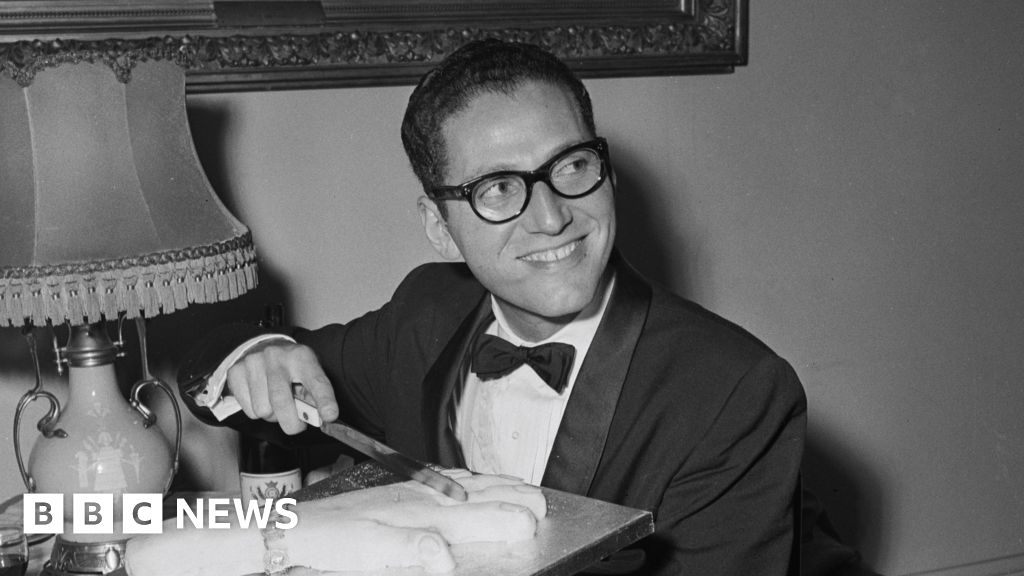
Remembering Tom Lehrer: A Master Satirist

Introduction
Tom Lehrer, the master satirist of the Cold War era, passed away at the age of 97. Though his career spanned over five decades, Lehrer will always be remembered for his sharp wit and biting humor that brilliantly skewered clichés about romance, patriotism, and small-town life.
The Power of Satire
Lehrer's satirical songs were not only entertaining but also thought-provoking. He used humor to challenge societal norms and expose the absurdity of certain beliefs and behaviors. Whether it was his song "National Brotherhood Week" that mocked the superficiality of unity or "The Old Dope Peddler" that highlighted the hypocritical view on drugs, Lehrer's lyrics were a reflection of the times and the issues that needed to be addressed.
A Legacy to Remember
Despite being known for his satirical songs, Lehrer was also a talented mathematician and lecturer. His songs were often filled with clever wordplay and references to science and mathematics, showcasing his intelligence and wit. Though he retired from the music industry in the 1960s, his influence can still be seen in popular satirical acts such as "Weird Al" Yankovic and The Lonely Island.
About the People Mentioned
Tom Lehrer
Tom Lehrer was an American mathematician, satirist, songwriter, and pianist, born on April 9, 1928, in Manhattan, New York City. He entered Harvard University at age 15, earning a Bachelor of Arts in mathematics in 1946 and a Master of Arts in 1947. Lehrer remained at Harvard as a graduate student until 1953, but never completed a doctorate, and preferred to be addressed as "Mr. Lehrer." Lehrer began writing and performing satirical songs in the early 1950s, initially to amuse friends. His first album, "Songs by Tom Lehrer," was released in 1953 and sold from his home by mail, eventually becoming an underground hit. He gained wider recognition with subsequent albums, including "More of Tom Lehrer" (1959) and the live recording "An Evening Wasted with Tom Lehrer," which was nominated for a Grammy in 1960. His songs, known for their wit, wordplay, and sharp social commentary, lampooned topics such as politics, science, and social conventions. Notable songs include "Poisoning Pigeons in the Park," "The Old Dope Peddler," "The Vatican Rag," and "The Elements," which set the names of chemical elements to music. Lehrer served in the U.S. Army from 1955 to 1957. In the 1960s, he wrote songs for the satirical television show "That Was The Week That Was." He largely retired from public performances in the 1970s, returning to teaching mathematics, notably at the University of California, Santa Cruz, until his retirement. Lehrer's work remains influential for its clever lyrics and satirical edge. He died on July 26, 2025, in Cambridge, Massachusetts, at the age of 97.
Weird Al Yankovic
Alfred Matthew "Weird Al" Yankovic, born October 23, 1959, in Downey, California, is an American musician, satirist, parodist, songwriter, record producer, actor, and author renowned for his humorous song parodies and music videos.[1][5] He began his career as a shy accordion-playing teenager submitting homemade tapes to the Dr. Demento radio show, gaining early fame with "Another One Rides the Bus" (a parody of Queen's "Another One Bites the Dust") in 1980.[4][5] Yankovic's breakthrough came in 1984 with "Eat It," a parody of Michael Jackson's "Beat It," which earned national recognition.[1][5] He has released 14 studio albums since his 1983 self-titled debut, including hits like *Straight Outta Lynwood* (2006), featuring his first Billboard Top 10 single "White & Nerdy" (peaking at No. 9), and *Mandatory Fun* (2014), his first No. 1 album and a Grammy winner for Best Comedy Album.[1][2][5] Other notable parodies include "Smells Like Nirvana," "Amish Paradise," "Fat," and "Word Crimes." He has sold over 12 million albums worldwide, with four gold and six platinum records in the U.S., and earned five Grammy Awards plus 11 nominations.[1][3][4] Beyond music, Yankovic wrote, directed, and starred in the 1989 cult film *UHF*, hosted *The Weird Al Show* (1997), and appeared in shows like *The Simpsons* and *30 Rock*, plus MTV/VH1 specials.[1][4] A Lynwood High School valedictorian and Cal Poly San Luis Obispo architecture graduate, he received a Hollywood Walk of Fame star in 2018.[1][3][4] Yankovic remains relevant with a five-decade career outlasting many parody targets, recent Grammy wins (including for *Squeeze Box*), and tours like *The Ridiculously Self-Indulgent, Ill-Advised Vanity Tour*.[2][4] He continues performing intimate shows with his longtime band.[4]
The Lonely Island
**The Lonely Island** is an American comedy trio consisting of Andy Samberg, Akiva Schaffer, and Jorma Taccone, who grew up together in Berkeley, California, and formed the group in 2001 after naming their Los Angeles apartment "The Lonely Island."[1][2][3] They gained fame through viral internet videos and their work on *Saturday Night Live* (SNL), where Samberg joined as a cast member in 2005 and Schaffer and Taccone as writers, following a recommendation from Jimmy Fallon after their 2005 MTV Movie Awards gig.[1][2][4] The group pioneered SNL Digital Shorts, producing hit comedic rap videos like "Lazy Sunday," "Dick in a Box," "Jizz in My Pants," "I'm on a Boat," and "Like a Boss," which blended hip-hop parody with absurd humor.[1][2][3] They released three albums: *Incredibad* (2009), *Turtleneck & Chain* (2011), and *The Wack Album* (2013).[1][3][8] Notable projects include the film *Hot Rod* (2007), directed by Schaffer and starring Samberg; the mockumentary *Popstar: Never Stop Never Stopping* (2016), which satirized pop music; and the Netflix special *The Unauthorized Bash Brothers Experience* (2019).[3][4] Individually, members have thrived: Samberg starred in *Brooklyn Nine-Nine* and co-created *Digman!* (2023–present); Schaffer and Taccone have directed films and TV.[4] The trio remains active, releasing the music video "Here I Go" featuring Charli XCX in 2024, as announced on their official site.[3][6] With over two decades in comedy, they continue influencing digital humor and music parody.[1][2][3] (298 words)