Broadcom Shares Slide as AI Growth Expectations Meet Skepticism
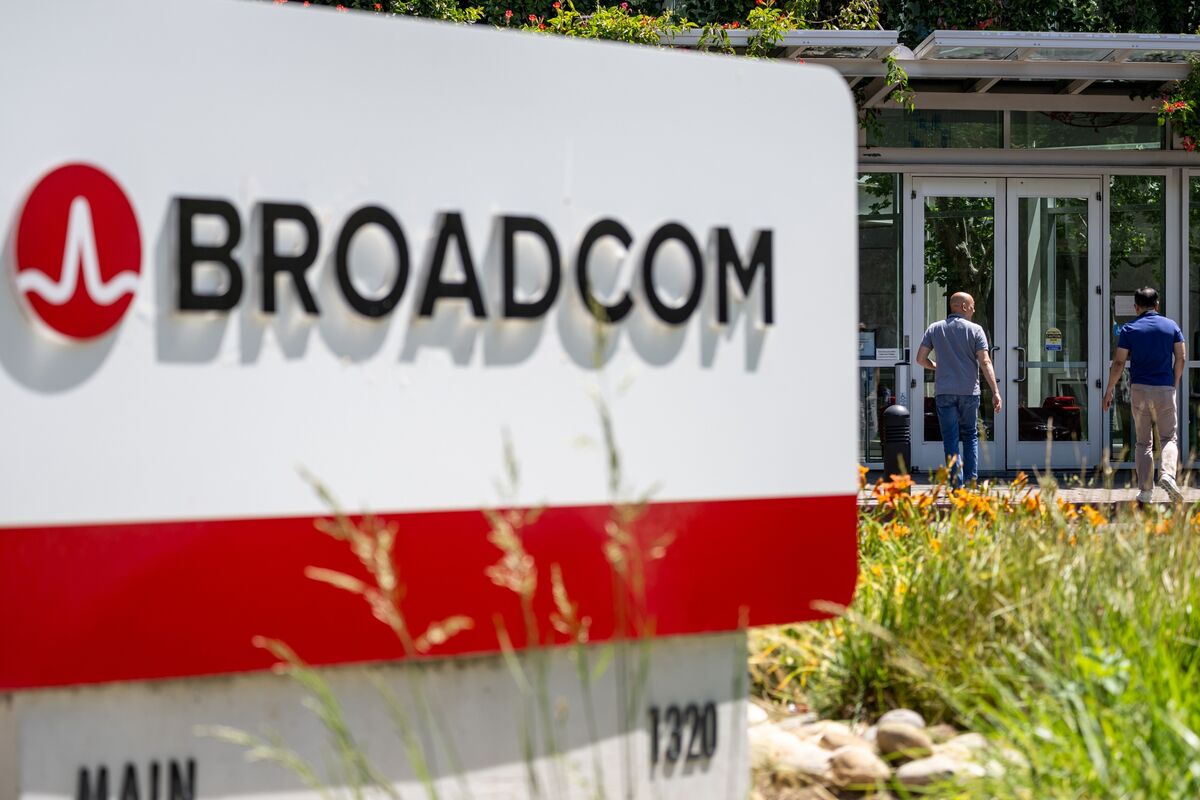
Broadcom Shares Slide Amid AI Expectations
Broadcom Inc., a key contender against Nvidia in AI chip dominance, saw its shares tumble after disappointing sales forecasts for the booming AI sector. Investors, hungry for explosive growth, reacted sharply to guidance that fell short of sky-high hopes despite robust recent performance.
Strong AI Revenue Growth Meets Investor Skepticism
In Q4 FY2025, Broadcom achieved record revenue of about $18 billion, up 28% year-over-year, driven by $6.5 billion in AI semiconductors—a 74% surge. The company projects Q1 FY2026 AI sales doubling to $8.2 billion, backed by a $70 billion backlog and a massive $11 billion order from Anthropic. Fiscal 2025 totals hit $64 billion, blending high-margin software and chips, with free cash flow nearing $27 billion and a 10% dividend hike to $0.65.
Market Reaction and Future Outlook
Yet, the stock slumped as projections didn't dazzle enough, highlighting Wall Street's lofty AI benchmarks. Broadcom's pivot to custom silicon and hyperscaler deals signals sustained momentum, but tempering expectations may reshape investor sentiment in this red-hot market.
About the Organizations Mentioned
Broadcom Inc.
Broadcom Inc. is a global infrastructure technology company that designs and supplies semiconductors and enterprise software used in networking, broadband, data centers, storage, and cybersecurity infrastructure for cloud, telecom and enterprise customers[4][5].[4][5] Founded through a series of predecessor businesses and mergers, the firm traces industrial roots to Hewlett‑Packard’s engineering lineage and the original Broadcom Corporation (founded in 1991 by Henry Samueli and Henry Nicholas), but the modern Broadcom Inc. emerged when Avago Technologies acquired Broadcom Corporation in 2016 and adopted the Broadcom name, creating the entity that trades under ticker AVGO[1][3][4].[1][3][4] Broadcom’s product portfolio spans system-on-a-chip solutions for wired and wireless communications, network switching and Ethernet PHYs, storage adapters, set‑top and broadband chips, plus a growing suite of infrastructure software acquired through major transactions such as CA Technologies (2018) and other enterprise‑software buys that shifted the company toward high‑margin, recurring‑revenue software offerings[1][3][2].[1][3][2] Key achievements include becoming a dominant supplier of networking and broadband semiconductors, executing a transformative 2016 mega‑merger that substantially increased scale and patent strength, and successfully pivoting into enterprise software to diversify revenue and margins[1][3][2].[1][3][2] Today Broadcom is headquartered in Palo Alto and led by CEO Hock E. Tan; it is widely recognized for aggressive acquisition strategy, strong cash generation, and concentration on mission‑critical infrastructure components and software for hyperscalers, telecoms and enterprises[2][4].[2][4] Notable aspects and controversies: Broadcom’s rapid consolidation strategy and market power have attracted regulatory and antitrust scrutiny in multiple jurisdictions, and its business model —
Nvidia
Nvidia Corporation, founded in 1993 by Jensen Huang, Chris Malachowsky, and Curtis Priem and headquartered in Santa Clara, California, is a pioneering American technology company best known for inventing the graphics processing unit (GPU) in 1999[1][2][4]. Initially focused on GPUs for video gaming, Nvidia has expanded its scope to serve diverse markets, including artificial intelligence (AI), high-performance computing (HPC), professional visualization, automotive technology, and mobile devices[1][3]. Nvidia’s GPUs, such as the GeForce series for gamers and the RTX series for professional applications, are central to its dominance, controlling over 90% of the discrete GPU market as of early 2025[1][4]. The company’s investment in CUDA, a parallel computing platform and API launched in the early 2000s, revolutionized GPU computing by enabling GPUs to accelerate a wide range of compute-intensive tasks, particularly in AI and scientific research[1][4]. By 2025, Nvidia commanded over 80% of the GPU market for AI training and inference and supplied chips to more than 75% of the world’s top 500 supercomputers[1]. Nvidia’s influence extends beyond hardware. It offers a comprehensive ecosystem including software platforms like Omniverse for 3D simulation and digital twins, AI frameworks such as MONAI for medical imaging, and Jetson for robotics and edge AI[2][3]. Its technologies power autonomous vehicle data centers, AI factories, and cloud gaming services like GeForce Now[2][7]. Financially, Nvidia achieved record full-year revenue of $130.5 billion in fiscal 2025, with a workforce of over 36,000 employees worldwide and a robust patent portfolio exceeding 8,700 applications[2]. The company is recognized for innovation and workplace excellence, topping Forbes’ "America’s Best Companies 2025" and Fast Company’s "World’s Most Innovative Companies"
Anthropic
Anthropic is an American artificial intelligence (AI) startup founded in 2021 by former OpenAI executives Dario Amodei, Daniela Amodei, Jack Clark, Sam McCandlish, and Tom Brown. The founders left OpenAI over concerns about AI safety and alignment, particularly disagreeing on OpenAI’s partnerships and strategic direction. Anthropic was established as a public-benefit corporation, emphasizing the development of AI systems that are **safe, reliable, interpretable, and aligned with human values**—balancing shareholder interests with broader societal good[2][4][5]. Since its inception, Anthropic has rapidly grown both in workforce and market presence. From only 192 employees in 2022, it expanded to 1,097 employees globally by 2025, marking a nearly sixfold increase in three years, reflecting aggressive scaling especially in 2023-2024[1][3]. This workforce supports Anthropic’s mission to build large language models (LLMs) that are *helpful, honest, and harmless* while advancing techniques to make AI behavior more predictable and controllable[4]. Anthropic’s funding success is remarkable, having raised approximately $7.3 billion in multiple rounds within just a few years, including a $4 billion commitment from Amazon in 2024 and a record $13 billion financing round in September 2025. These investments have propelled the company's valuation to around $61.5 billion[2][3]. This financial backing underscores substantial investor confidence in Anthropic's vision and technology. The company is known for its flagship AI models like the “Claude” series, with recent releases such as Claude 3.5 and Claude Sonnet 4.5, which are competitive with industry leaders like GPT-4 in natural language understanding and coding tasks[2][6]. Anthropic also actively collaborates with academic institutions and regulators to formalize AI safety standards, reinforcing its leadership in ethical AI development[3].