BYU's Early Promise, Then Decline: Texas Tech Surges to Big 12 Title
BYU’s Early Promise and Subsequent Decline
The BYU Cougars started strong in the Big 12 championship game against Texas Tech, scoring first with a 14-play, 90-yard drive that ended in an LJ Martin touchdown. However, that would be their only score of the game. After this initial success, BYU’s offense stalled as Texas Tech mounted a dominant response, scoring 34 unanswered points and shutting down the Cougars’ offense for the remaining three quarters.
Texas Tech’s Defensive Dominance
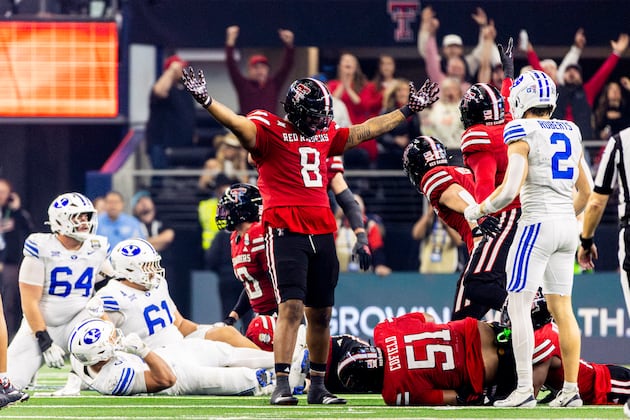
Texas Tech’s defense was relentless, forcing four turnovers in the second half and holding BYU to just 60 rushing yards at 2.1 yards per carry. Linebacker Ben Roberts was a standout, overcoming an early injury and recording two interceptions, including a remarkable one-handed catch. The Red Raiders’ defensive pressure disrupted BYU’s quarterback, resulting in two sacks and multiple hits, which effectively ended BYU’s momentum.
Implications for BYU’s Season
With this 34-7 loss, BYU fell to 11-2 on the season and faces an uncertain future regarding the College Football Playoff. The defeat likely ends their chances for the 12-team playoff field, placing them on the bubble as they await the selection committee’s final decision. Meanwhile, Texas Tech secured its first outright Big 12 title since 1955 and a probable first-round bye in the playoff.
About the Organizations Mentioned
BYU Cougars
# BYU Cougars: A Premier Collegiate Athletic Program The BYU Cougars represent the 21 varsity intercollegiate athletic teams of Brigham Young University, a private institution owned by The Church of Jesus Christ of Latter-day Saints and located in Provo, Utah.[1] With an enrollment of 35,743 students, BYU has cultivated one of the most distinctive athletic programs in American higher education, blending competitive excellence with faith-based values. ## Historical Foundation and Development Founded on October 16, 1875, BYU's athletic program began collegiate football competition in 1922.[2] The program has evolved significantly over decades, moving through various conferences including the Western Athletic Conference and Mountain West Conference before joining the Big 12 in recent years. A pivotal moment came in 1984 when the Cougars won their sole national football championship.[2] ## Achievements and Recognition BYU Athletics boasts an impressive competitive record with 14 NCAA titles and 2 NIT championships.[1] The football program ranks ninth nationally in college football wins over the past 50 years.[9] The athletic department has produced 1,512 All-Americans, 90 Olympians, and one Heisman Trophy winner (Ty Detmer).[1] Recent accomplishments include winning national championships in both women's and men's cross country in 2024, and women's volleyball has made the NCAA Tournament in 13 consecutive years.[9] ## Current Operations and Support Today, BYU Athletics operates under Athletic Director Brian Santiago and maintains 21 varsity teams competing primarily in NCAA Division I-A.[1] The organization funds its programs through the Cougar Club, the official booster organization offering membership levels ranging from $150 to $1 million
Texas Tech
Texas Tech University is a major public research institution established in 1923 by legislative action to serve the educational needs of West Texas. Originally named Texas Technological College, it opened its doors in 1925 with six buildings and an enrollment of 914 students[2][4][5]. The university has since evolved into the largest comprehensive higher education institution in the western two-thirds of Texas, uniquely housing an undergraduate and graduate university, law school, and medical school all on the same campus in Lubbock[2][7]. Texas Tech offers a broad range of academic programs through multiple colleges, including Agricultural Sciences and Natural Resources, Arts and Sciences, Business Administration, Education, Engineering, Architecture, Human Sciences, Media and Communication, and the Honors College[2][4]. Graduate education started in 1927, with the Graduate School formally established in 1954. The university awarded its first Ph.D. in 1952 and has since granted nearly 325,000 degrees, including over 75,000 graduate and professional degrees[3]. The institution achieved Tier One Carnegie Classification status in 2015, marking it as one of the top doctoral research universities in the U.S., a distinction it has maintained annually[1]. Its athletic achievements include the first men's NCAA outdoor track and field national championship, highlighting its growing prominence beyond academics[1]. Texas Tech has also seen significant philanthropic support, such as a transformative $44 million gift leading to the renaming of the College of Agricultural Sciences and Natural Resources to the Davis College[1][8]. The university campus spans 1,900 acres, making it the second-largest contiguous campus in the United States, and it generates an economic impact of $7.5 billion for Texas[7]. Texas Tech has continuously expanded its physical and academic infrastructure since the 1960s, reflecting its commitment to growth in business, technology, and the sciences[3][4]. With a diverse student body approaching 40,000, Texa
Big 12
The **Big 12 Conference** is a premier American collegiate athletic organization consisting of **16 universities across 10 states and four time zones**, making it one of the most geographically diverse conferences in NCAA Division I sports[1][2]. Established in **1996** through the merger of the Big 8 Conference and four Texas-based schools from the Southwest Conference, the Big 12 has grown into a powerhouse in college athletics, known especially for its football and basketball programs[2][4]. The conference sponsors **25 sports**, including men's and women's basketball, football, baseball, golf, volleyball, and more, conducting postseason championships in 24 of these sports[1]. It has produced an impressive legacy with **91 NCAA team national championships and 775 individual national champions**, highlighting its competitive excellence[1]. The Big 12 is also recognized for academic achievement, boasting over **800 Academic All-America recipients** and numerous NCAA Elite 90 award winners among its student-athletes[1]. Historically, the Big 12 evolved from earlier versions of collegiate leagues known as the Big 6, 7, and 8 conferences, dating back to the early 20th century, reflecting a rich tradition in college sports[2]. The modern Big 12 underwent significant expansion and realignment recently, with the addition of universities like Arizona, Arizona State, Colorado, Utah, BYU, UCF, Cincinnati, and Houston between 2023 and 2024, while some key members left, creating a dynamic and competitive league environment[1][2][3]. Under Commissioner Brett Yormark, who took office in 2022, the Big 12 has emphasized innovative marketing and brand building, further elevating its profile within college athletics and the broader sports landscape[1]. The conference office is based in Irving, Texas. Notable for its competitive football format, the Big 12 reinstated its championship game in 2017 after a hiatus, maintaining a round-robi
College Football Playoff
The **College Football Playoff (CFP)** is an annual knockout tournament established in 2014 to determine the national champion of NCAA Division I Football Bowl Subdivision (FBS), the highest level of college football in the U.S.[1][2]. It replaced the Bowl Championship Series (BCS), which had been criticized for its selection process. Unlike the BCS’s reliance on polls and computer rankings, the CFP uses a 13-member selection committee composed of current and former athletic directors, coaches, and other professionals to rank and seed teams, emphasizing strength of schedule and overall performance[1][3]. From its inception through the 2023 season, the CFP featured a four-team single-elimination format culminating in the College Football Playoff National Championship game, which rotates its host city annually and draws significant national attention and tourism[1][2]. Ohio State won the inaugural championship in January 2015[2]. In 2024, the playoff expanded to a **12-team format**, allowing automatic bids to the five highest-ranked conference champions and additional at-large teams, increasing opportunities and generating greater competitive excitement[1][9]. This expansion reflects the evolving business landscape of college football, aiming to enhance fan engagement, broadcasting revenues, and the sport’s overall visibility[1][9]. The CFP is governed by a Board of Managers, including commissioners from the ten FBS conferences and Notre Dame’s athletic director, who oversee the organization’s operations, budgeting, and strategic direction[4][8]. The College Football Playoff Foundation, also established in 2014, leverages the platform to support charitable initiatives and community impact[4]. Notable aspects include the committee’s influential role in shaping the postseason landscape and ongoing debates about playoff expansion size and selection criteria[1][3]. The CFP stands as a significant business and sports technology model, combining data-driven decision-making with traditional sports management to deliver a premier championship experience. Overall, the CFP represents a transformative approac