McKenna Sizzles for Penn State in Beaver Stadium Thriller, Fueling NHL Draft Buzz
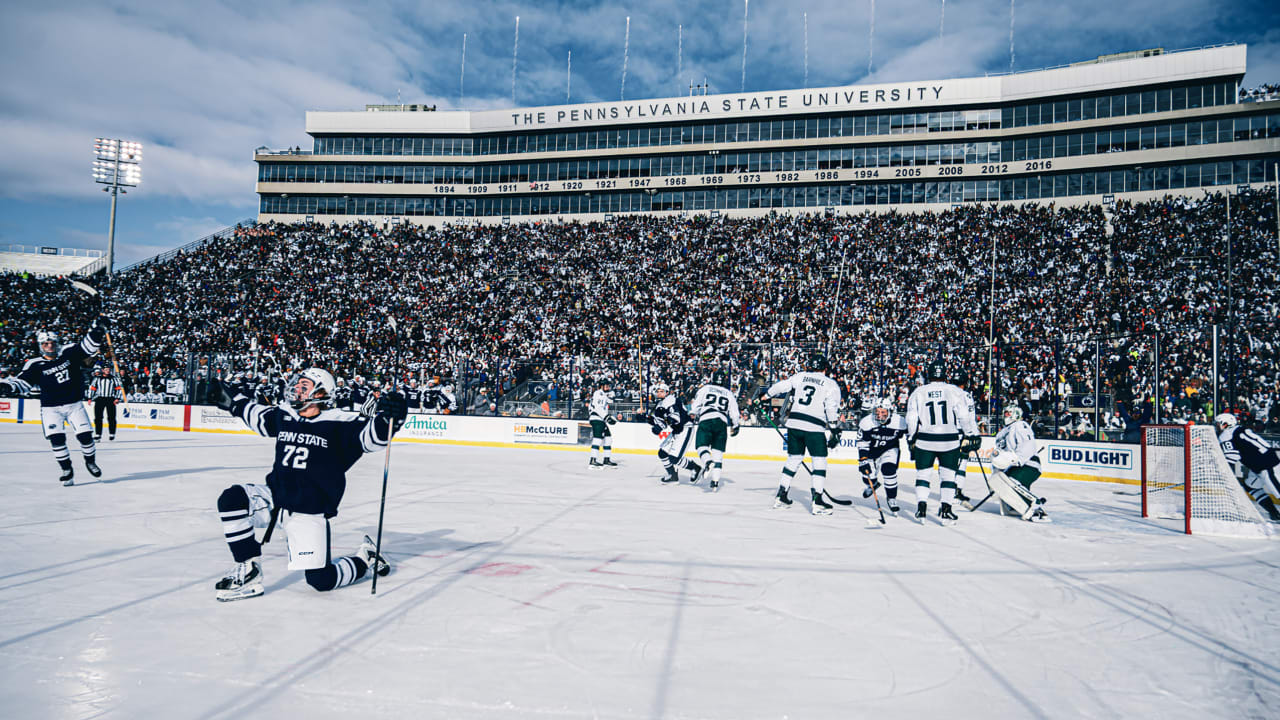
Mckenna Sizzles in Penn State Thriller at Beaver Stadium
Projected top pick in the 2026 NHL Draft, McKenna delivered a scorching performance outdoors at iconic Beaver Stadium, notching a goal and two assists in Penn State's overtime loss to Michigan State. The electric atmosphere amplified his skill, as he dazzled fans with precise passes and a sniper's finish amid chilly conditions.
Standout Plays and Draft Buzz
McKenna's three-point night highlighted his elite vision and scoring touch, setting up teammates for prime chances before burying his own marker. Facing a tough Michigan State defense, he logged heavy minutes, showcasing the hockey IQ that scouts rave about. This outing echoes top prospects like Connor Bedard, who piled up points in high-stakes games, fueling McKenna's rise on draft boards.
Future Implications for Nittany Lions and NHL
Despite the OT defeat, McKenna's heroics boosted Penn State's playoff hopes and solidified his status as a franchise cornerstone. As 2026 nears, his outdoor mastery signals readiness for NHL rigors, promising a bright pro career filled with game-changing moments.
About the Organizations Mentioned
Penn State
## Overview Pennsylvania State University, commonly known as Penn State, is a major public research university and Pennsylvania’s sole land-grant institution. It is renowned for its comprehensive mission of teaching, research, and public service, aiming to “improve the lives of the people of Pennsylvania, the nation, and the world through integrated, high-quality programs in teaching, research, and service”[5]. Penn State’s main campus is located in University Park, with 19 branch campuses across the state, a medical school in Hershey, a law school in Dickinson, and additional specialized institutions[5]. The university offers a broad range of degrees—associate, bachelor’s, master’s, doctoral, and professional—as well as continuing education programs[5]. ## History Founded in 1855 as the Farmers’ High School of Pennsylvania, Penn State’s origins reflect its commitment to practical education[1][2]. The institution was established with a 200-acre land donation from James Irvin and was initially focused on applying scientific principles to farming[1][3]. It was renamed the Agricultural College of Pennsylvania in 1862 and became the state’s land-grant college following the passage of the Morrill Act in 1863[2][3]. Under the leadership of President George W. Atherton in the 1880s, the curriculum expanded to include engineering, the sciences, liberal arts, and more, aligning with the broader mandate of land-grant institutions[1][2]. The university’s name changed to Pennsylvania State College in 1874 and finally to Pennsylvania State University in 1953[2][3]. ## Key Achievements Penn State has a long tradition of innovation in education and research. It was among the first institutions to integrate cooperative extension and outreach programs in the early 1900s, extending its academic influence statewide[1]. The university’s engineering program quickly became one of the ten largest in the nation[
Michigan State
Michigan State University (MSU) is a leading American public research university and the nation’s first land-grant institution, founded in 1855 as the Agricultural College of the State of Michigan[4]. MSU’s founding vision—to democratize higher education and make advanced, practical knowledge accessible to all—set a precedent for the Morrill Act of 1862, which established land-grant colleges across the U.S.[4]. Today, MSU is recognized globally for its research, innovation, and commitment to inclusive education, serving as a model for public universities worldwide[3][6]. ## History and Evolution Originally focused on agriculture, MSU expanded its curriculum in the early 20th century, reflecting its broader mission to serve the public good[2]. The university underwent significant growth after World War II under President John A. Hannah, whose leadership and use of the G.I. Bill propelled enrollment from 15,000 in 1950 to 38,000 by 1965[1][2]. In 1955, the institution was officially renamed Michigan State University of Agriculture and Applied Science, marking its transition to a comprehensive research university[1][2]. ## Key Achievements and Contributions MSU has a storied legacy of innovation, including pioneering advances in hybrid corn, homogenized milk, and the discovery of a cancer-fighting drug that has saved millions of lives[4]. The university’s research spans agriculture, engineering, medicine, business, and technology, consistently ranking among the top research institutions globally[3][6]. MSU also boasts a diverse and inclusive community, being among the first to admit women (1870), international students (1873), and African American students (1899)[2][7]. ## Current Status and Notable Aspects Today, MSU is a member of the prestigious Big Ten Conference and operates one of the largest and greenest campuses in the U.S., located in East Lansing, Michigan[5
NHL
The **National Hockey League (NHL)** is the premier professional ice hockey organization in North America, operating 32 teams—25 in the U.S. and 7 in Canada—across Eastern and Western Conferences with four divisions each.[1][2][3] Headquartered in Midtown Manhattan, New York City, it governs an 82-game regular season from October to April, followed by playoffs culminating in the Stanley Cup, North America's oldest professional sports trophy awarded since 1926.[1][2][5] Founded on November 26, 1917, in Montreal amid World War I disruptions to predecessor leagues, the NHL started with four Canadian teams: Montreal Canadiens, Montreal Wanderers, Ottawa Senators, and Quebec Bulldogs.[2][3][5] It expanded to the U.S. in 1924 with the Boston Bruins and stabilized as the "Original Six" (Bruins, Black Hawks, Red Wings, Canadiens, Rangers, Maple Leafs) from 1942 to 1967, a golden era of rivalries and stars.[1][2][5] Post-1967 expansion doubled teams to 12, surging to 21 by 1979 after merging with the World Hockey Association; further growth hit 30 by 2000 and 32 today, including recent additions like Utah Mammoth and Seattle Kraken.[2][3][5][6] Key achievements include full Stanley Cup control in 1947, global player diversity from over 20 countries, and innovations like salary caps, rule standardization influencing junior leagues, and international games in Europe and Asia.[1][3][5] Under Commissioner Gary Bettman since 1993, the NHL's Board of Governors—chaired by Boston's Jeremy Jacobs—oversees expansions, relocations, and policies.[1][5] Currently, as one of North America's "Big Four" leagues (second-oldest after MLB), the NHL trails in U.S