Trump's Tariff Threat Rattles Markets: EU Retaliation and Market Volatility

Trump's Tariff Threat Rattles Markets
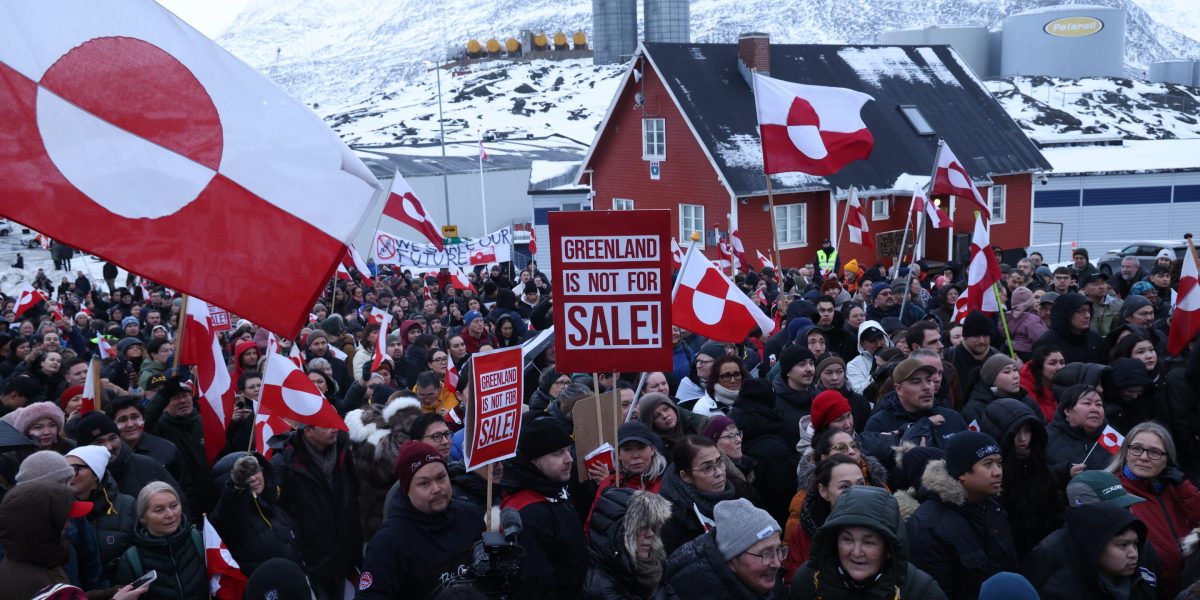
President Donald Trump's aggressive tariff threats over Greenland sent shockwaves through Wall Street on Tuesday, with the Dow closing down 870 points. The market decline reflects investor concerns as Trump threatens 10% tariffs on eight European nations, including Denmark, France, Germany, and the United Kingdom, effective February 1st, escalating to 25% by June 1st unless a deal for Greenland acquisition is reached.
European Pushback and Retaliation Plans
European leaders are mounting a coordinated response to Trump's demands. The European Commission is considering retaliatory tariffs on approximately $110 billion worth of U.S. goods and may activate EU laws targeting economic coercion. Members of the European Parliament have postponed a scheduled vote to lower tariffs on American products, signaling unified resistance to the administration's approach.
Market Implications Ahead
As tensions escalate, investors face uncertainty regarding potential trade war consequences. Trump's trade representative suggested the tariff threat could serve as a negotiating tactic, yet the administration has not issued official paperwork to implement the measures. Market volatility is expected to continue as negotiations unfold.
```About the People Mentioned
Donald Trump
Donald John Trump, born June 14, 1946, in Queens, New York, is an American businessman, media personality, and politician. He graduated from the University of Pennsylvania’s Wharton School in 1968 with a degree in economics. In 1971, he took over his family’s real estate business, renaming it the Trump Organization, through which he expanded into building and managing skyscrapers, hotels, casinos, and golf courses. Trump gained widespread fame as the host of the reality TV show *The Apprentice* from 2004 to 2015, which helped establish his public persona as a successful entrepreneur. Trump entered politics as a Republican and was elected the 45th president of the United States, serving from 2017 to 2021. His presidency was marked by significant policy actions including tax cuts, deregulation, the appointment of three Supreme Court justices, renegotiation of trade agreements (notably replacing NAFTA with the USMCA), and a focus on immigration control including border wall expansion. He withdrew the U.S. from international agreements such as the Paris Climate Accord and the Iran nuclear deal, and engaged in a trade war with China. His administration’s response to the COVID-19 pandemic was criticized for downplaying the virus’s severity. Trump was impeached twice by the House of Representatives—first in 2019 for abuse of power and obstruction, and again in 2021 for incitement of insurrection—but was acquitted by the Senate both times. After losing the 2020 election to Joe Biden, Trump challenged the results, culminating in the January 6, 2021, Capitol riot. He remains a central figure in American politics, having won the 2024 presidential election and returned as the 47th president in 2025, continuing to promote policies aimed at economic growth, border security, and military strength[1][2][3][4].
About the Organizations Mentioned
European Commission
The European Commission is the executive branch of the European Union (EU), responsible for proposing legislation, implementing decisions, upholding the EU treaties, and managing the day-to-day business of the Union. Its primary role is to act as the “guardian of the treaties,” ensuring that EU law is applied uniformly across all member states. The Commission is composed of one commissioner from each EU country, led by a President—currently Ursula von der Leyen—who sets the political direction for the institution. ## History and Evolution Established in 1958 as part of the European Economic Community, the Commission’s powers and responsibilities have expanded alongside the EU itself. Over decades, it has evolved from a technocratic body focused on economic integration to a central player in shaping Europe’s political, social, and digital future. The Commission has been instrumental in creating the single market, launching the euro currency, and driving forward major treaties such as Maastricht and Lisbon. ## Key Achievements The Commission has overseen transformative projects like the European Green Deal, aiming to make Europe the first climate-neutral continent by 2050, and the Digital Single Market, which seeks to harmonize digital regulations and boost Europe’s tech competitiveness. It has also been a driving force behind landmark regulations in data protection (GDPR), artificial intelligence (AI Act), and antitrust enforcement against global tech giants. ## Current Status and Priorities In 2025, the Commission’s work programme underscores a focus on sustainable prosperity, security, competitiveness, and regulatory simplification[1][2][4]. Major initiatives include the Clean Industrial Deal to decarbonize industry, the AI Continent Action Plan to position Europe as a leader in artificial intelligence, and a push to reduce administrative burdens by at least 25% for businesses—especially small and medium-sized enterprises (SMEs)[1][3][6]. The Commission is also prioritizing the modernization of the single market, investment in clean energy, and strengthening Europe’s strategi
European Parliament
The **European Parliament (EP)** is the European Union's directly elected legislative body, comprising **720 Members of the European Parliament (MEPs)** who represent over 450 million citizens across 27 member states.[1][2][4] Elected every five years—most recently in 2024—it shares **equal legislative and budgetary powers** with the Council of the EU, approving laws proposed by the European Commission, international agreements, EU enlargements, and the multiannual budget.[1][4][5] Founded in **1952** as the Common Assembly of the European Coal and Steel Community, it was renamed the European Parliament in **1962**, with the first direct elections held in **1979**—a milestone enhancing democratic legitimacy.[1][2] Over decades, treaties like Maastricht expanded its clout: from advisory roles to **co-decision** (now ordinary legislative procedure) across key areas like the internal market, environment, digital tech, data protection (e.g., GDPR), energy transition, and AI regulation—vital for businesses navigating EU-wide standards.[2][5][6] Key achievements include electing Commission Presidents via the **Spitzenkandidaten** process (e.g., Jean-Claude Juncker in 2014), scrutinizing executive actions through inquiries (mad cow disease led to a veterinary agency), and vetoing trade deals or budget misuse.[2][6] It approves Commission rosters post-hearings, ensuring accountability, and monitors monetary policy with the European Central Bank.[1][2] Currently led by **President Roberta Metsola** (since 2022), the EP operates via **20 committees** (e.g., on Industry, Research, and Energy; Internal Market and Consumer Protection) that draft amendments, feeding into monthly plenary sessions in **Strasbourg** (plenary votes) and **Brussels** (committees).[1][3] Its **supervisory powers**—questio