Utah Mammoth to Host 2027 NHL Winter Classic at Rice-Eccles Stadium
#nhl #winter_classic #utah_mammoth #colorado_avalanche #outdoor_hockey
Utah Mammoth Secure Historic 2027 Winter Classic
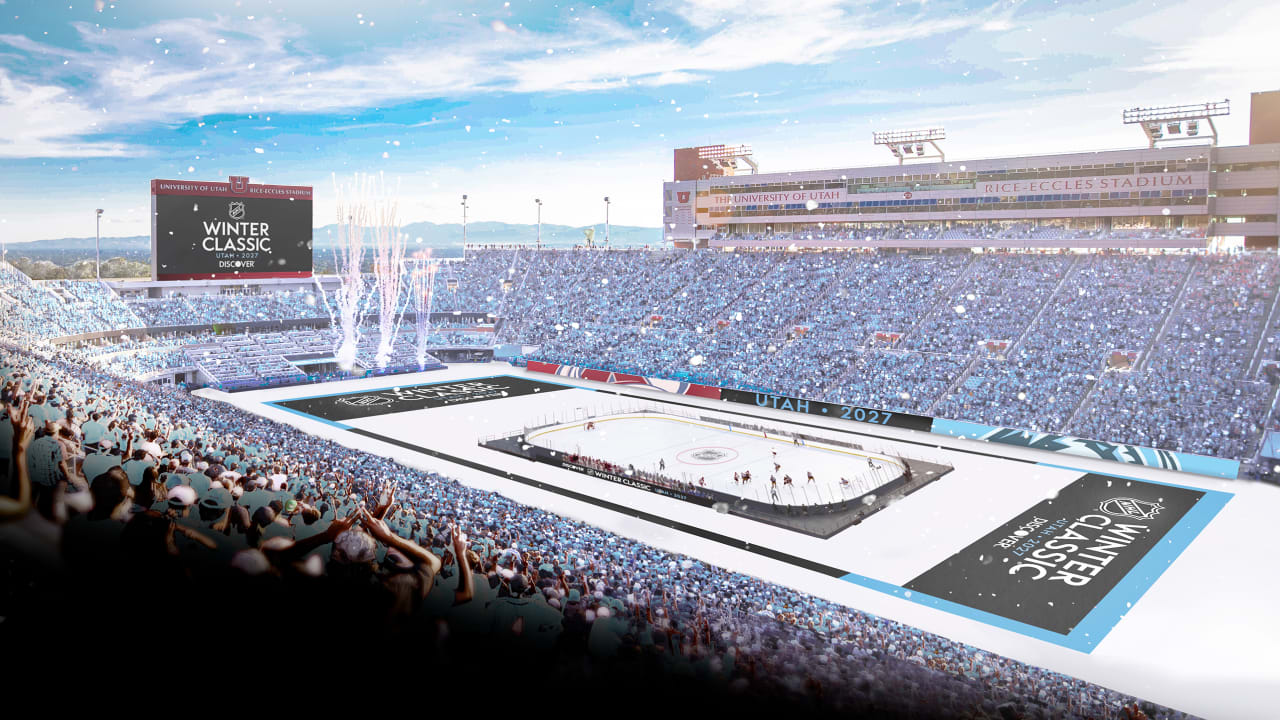
The Utah Mammoth have been selected to host the 2027 Discover NHL Winter Classic at Rice-Eccles Stadium on the University of Utah campus[1][2]. This prestigious outdoor game will feature the Mammoth facing off against the Colorado Avalanche, marking a significant milestone for the franchise[1]. Just two years into their existence, Utah becomes the 32nd NHL team to participate in an outdoor game[2].
A Landmark Moment for the Franchise
The Mammoth relocated to Salt Lake City from Arizona ahead of the 2025 season and have already achieved remarkable success[4]. This Winter Classic announcement represents the 18th edition of the NHL's premier outdoor event and will be Utah's first outdoor hockey game[5]. The stadium's location between mountains and downtown Salt Lake City provides a picturesque setting for this celebration[3].
Community Excitement and Legacy
Owner Ryan Smith expressed enthusiasm about bringing this prestigious event to Utah, emphasizing the franchise's commitment to the community[4]. The Winter Classic traditionally blends local culture with professional hockey, creating unforgettable experiences for fans nationwide[5].
```About the Organizations Mentioned
Utah Mammoth
The **Utah Mammoth** is a professional ice hockey team competing in the National Hockey League (NHL) as a member of the Central Division, based in Salt Lake City.[2] The franchise represents a major sports expansion for the region and was established through an innovative acquisition strategy. ## History and Establishment The team was created on April 18, 2024, when NHL Board of Governors granted an expansion franchise to Ryan Smith, owner of the NBA's Utah Jazz and co-owner of Major League Soccer's Real Salt Lake.[2] Rather than conducting a traditional expansion draft, Smith Entertainment Group (SEG) acquired the hockey assets—including players, coaching staff, and draft picks—from the Arizona Coyotes, which suspended operations simultaneously.[2] The team began its inaugural 2024-25 season under the temporary name "Utah Hockey Club" before receiving its permanent identity.[6] ## Brand Identity and Community Focus On May 7, 2025, SEG officially unveiled the **Utah Mammoth** as the franchise's permanent name and brand identity.[3] The name was selected through an unprecedented four-round community voting process that gathered over 850,000 ballots from fans.[6] The mammoth symbolizes strength and resilience, qualities historically embodied by the creatures that roamed Utah over 10,000 years ago.[3] The primary logo features a mountain mammoth mid-charge with design elements incorporating Utah's Wasatch Mountain Range, the state's silhouette, and a curved tusk forming the letter "U."[3] ## Infrastructure and Community Initiatives SEG constructed a state-of-the-art 115,780-square-foot training facility in Sandy featuring two NHL-standard ice surfaces, medical facilities, and recovery amenities.[1] The organization prioritizes community engagement through its Hockey 101 program, which has already served over
Colorado Avalanche
The **Colorado Avalanche** is a professional ice hockey franchise based in Denver, competing in the NHL’s Western Conference, Central Division, and playing home games at **Ball Arena**, which it shares with the NBA’s Denver Nuggets and NLL’s Colorado Mammoth.[4] The team is owned by **Kroenke Sports & Entertainment (KSE)**, with E. Stanley Kroenke as owner/chairman and Josh Kroenke serving as president, situating the club inside a broader global sports and media portfolio that includes major US and European teams and an emerging esports arm.[2][4] Founded in 1972 as the **Quebec Nordiques** in the World Hockey Association, the franchise joined the NHL in 1979 through the NHL–WHA merger.[1][3][4] After financial struggles in Quebec, COMSAT Entertainment Group relocated the team to Denver in 1995, rebranding it as the Colorado Avalanche.[1][3][4] The move immediately created a high‑value NHL property in a fast‑growing media market, leveraging Denver’s arena infrastructure and cross‑team synergies under KSE. On the ice, the Avalanche is one of the league’s elite modern-era brands, winning **three Stanley Cups** (1996, 2001, 2022).[2][3] The club’s early Colorado years were defined by stars **Joe Sakic, Peter Forsberg, Patrick Roy, and Adam Foote**, establishing a winning culture and strong regional fan base.[1][3][4] Under KSE, the organization has added **multiple division titles** and **two Presidents’ Trophies** (2001, 2021), reflecting sustained regular-season excellence.[2] Currently coached by **Jared Bednar** with **Chris MacFarland** as general manager, Colorado has been a consistent playoff team and division leader in recent seasons.[3][5][7]
NHL
The **National Hockey League (NHL)** is the premier professional ice hockey organization in North America, operating 32 teams—25 in the U.S. and 7 in Canada—across Eastern and Western Conferences with four divisions each.[1][2][3] Headquartered in Midtown Manhattan, New York City, it governs an 82-game regular season from October to April, followed by playoffs culminating in the Stanley Cup, North America's oldest professional sports trophy awarded since 1926.[1][2][5] Founded on November 26, 1917, in Montreal amid World War I disruptions to predecessor leagues, the NHL started with four Canadian teams: Montreal Canadiens, Montreal Wanderers, Ottawa Senators, and Quebec Bulldogs.[2][3][5] It expanded to the U.S. in 1924 with the Boston Bruins and stabilized as the "Original Six" (Bruins, Black Hawks, Red Wings, Canadiens, Rangers, Maple Leafs) from 1942 to 1967, a golden era of rivalries and stars.[1][2][5] Post-1967 expansion doubled teams to 12, surging to 21 by 1979 after merging with the World Hockey Association; further growth hit 30 by 2000 and 32 today, including recent additions like Utah Mammoth and Seattle Kraken.[2][3][5][6] Key achievements include full Stanley Cup control in 1947, global player diversity from over 20 countries, and innovations like salary caps, rule standardization influencing junior leagues, and international games in Europe and Asia.[1][3][5] Under Commissioner Gary Bettman since 1993, the NHL's Board of Governors—chaired by Boston's Jeremy Jacobs—oversees expansions, relocations, and policies.[1][5] Currently, as one of North America's "Big Four" leagues (second-oldest after MLB), the NHL trails in U.S
Rice-Eccles Stadium
Rice–Eccles Stadium is an outdoor **college football and events venue** on the University of Utah campus in Salt Lake City, serving as the home field of the Utah Utes, now in the **Big 12 Conference**, and a multipurpose stage for major sports, concerts, and global ceremonies.[2][6] The stadium’s roots trace back to **Ute Stadium**, opened in 1927 as the university’s first on-campus football facility.[2][3][6] A major expansion in 1972 boosted capacity from 20,000 to 32,500 seats and renamed it **Rice Stadium** after businessman and alumnus Robert L. Rice, who contributed $1 million to the project.[3] Salt Lake City’s successful bid for the **2002 Winter Olympics** triggered a full rebuild in 1997–98, funded in part by a **$10 million gift** from the George S. and Dolores Doré Eccles Foundation.[1][2][6] The old structure was demolished after the 1997 season and replaced in under a year with a modern concrete-and-glass facility opened on September 12, 1998, initially seating about 45,000.[1][6][7] In recognition of the Eccles contribution, the venue became **Rice–Eccles Stadium**.[1][2][3][6] It hosted the **Opening and Closing Ceremonies of the 2002 Winter Olympics** and is expected to reprise that role for the **2034 Winter Games**, giving it enduring strategic significance in the sports-event economy.[2][4][5] Architecturally, Rice–Eccles was among the first U.S. stadiums to integrate **large hospitality and premium spaces** into the press box concept, anticipating the modern revenue model built around suites, clubs, and corporate hosting.[5] A major **$80 million south end zone expansion** completed i
University of Utah
The **University of Utah** is a prestigious public research university in Salt Lake City, Utah, established in 1850 as the University of Deseret, making it the oldest state university west of the Missouri River. It was renamed the University of Utah in 1894 and moved to its current campus in 1900, serving as Utah's flagship institution of higher education[2][3]. With a fall 2023 enrollment of over 35,000 students, it is the second-largest public university in Utah, offering degrees in 64 undergraduate and 90 graduate-level subjects across diverse disciplines[2][3]. The university is renowned for its strong emphasis on research and innovation, ranking 47th nationally in research and development funding with $670 million in 2022[2]. It holds an "R1: Doctoral Universities – Very high research activity" classification and is a member of the Association of American Universities (AAU), reflecting its comprehensive research capabilities[2]. The health system affiliated with the university includes four hospitals and specialty centers such as the Huntsman Cancer Institute and the Moran Eye Center, notable for pioneering medical achievements like the first artificial heart implantation and rapid genomic diagnosis for critically ill infants[1][2]. The John and Marcia Price College of Engineering, rooted in Utah's mining industry history, has been influential in technology and industry. It has produced alumni and faculty who founded or contributed to major tech companies like Adobe, Pixar, Netscape, and Novell[4]. The college currently supports over 5,000 undergraduates and 1,350 graduate students, with $106 million in annual research expenditures, underscoring its role in advancing engineering and technology[4]. The university’s distinguished community includes 22 Rhodes Scholars, four Nobel laureates, three Turing Award winners, and multiple MacArthur Fellows, emphasizing its impact on academia, technology, and business globally[2]. It also operates public media outlets and cultural institutions, enriching the broade