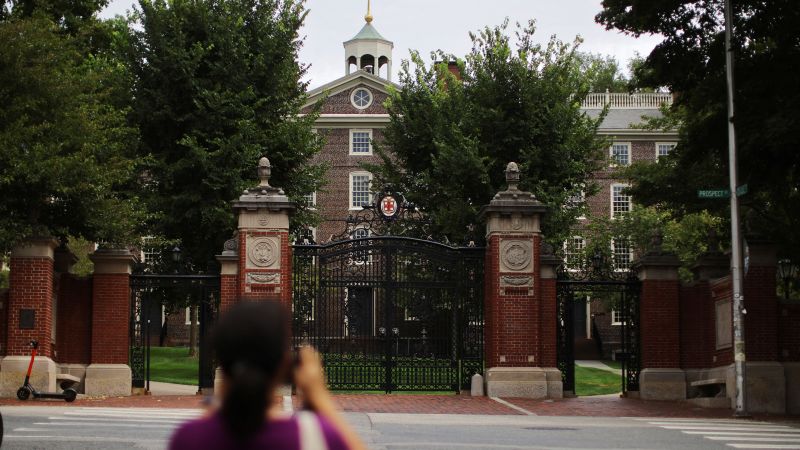
Arrest Warrant Issued in Brown University Attack Linked to MIT Professor Shooting

Police issue arrest warrant after Brown University attack
Authorities announced an arrest warrant for a suspect linked to last week’s mass shooting at Brown University, saying investigators also connected the individual to the fatal shooting of an MIT professor, according to officials following the manhunt.
Investigation and timeline
Officials described a dayslong search that traced the suspect’s movements across state lines, with forensic teams examining ballistic and DNA evidence to link scenes and establish chronology while stressing there is no indication of additional planned attacks at this time.
Campus response and implications
Brown and neighboring institutions have increased security reviews and counseling support for students and staff, and law enforcement urged the public to report tips as they complete forensic comparisons and pursue outstanding warrants to ensure community safety.
About the Organizations Mentioned
Brown University
## Overview Brown University, located in Providence, Rhode Island, is a private Ivy League research university renowned for its distinctive approach to undergraduate education, pioneering research, and strong commitment to social responsibility and innovation. Founded in 1764, Brown is the seventh-oldest institution of higher education in the United States and has built a reputation for academic excellence, interdisciplinary study, and a progressive ethos. ## What Brown University Does Brown offers a broad spectrum of undergraduate, graduate, and professional programs across the arts, humanities, social sciences, life sciences, physical sciences, and engineering. The university is particularly noted for its Open Curriculum, which empowers undergraduate students to design their own course of study without traditional distribution requirements—a hallmark of Brown’s educational philosophy. Graduate and professional programs, including the Warren Alpert Medical School, School of Public Health, and School of Engineering, foster cutting-edge research and prepare students for leadership roles in academia, industry, and public service. ## History Brown was established by Baptist minister James Manning and others, with significant early ties to Rhode Island’s mercantile and maritime history. The university was named in honor of Nicholas Brown, a prominent benefactor. Throughout its history, Brown has been at the forefront of educational reform, including the 1969 adoption of the Open Curriculum, which revolutionized higher education by prioritizing student autonomy and intellectual exploration. ## Key Achievements Brown has produced numerous Nobel laureates, Pulitzer Prize winners, and leaders in diverse fields. Its faculty and alumni have made groundbreaking contributions in areas such as medicine, technology, public policy, and the arts. Recent milestones include the establishment of the Lassonde Innovation and Design Hub, supporting entrepreneurship and technology development[1], and the launch of new graduate programs like the online master’s in business analytics[1]. Brown’s research initiatives frequently address global challenges, from public health to environmental sustainability. ## Current Status As of 2025, Brown continues to attract a highly selective and diverse student body,
MIT
The Massachusetts Institute of Technology (MIT) is a globally renowned private research university in Cambridge, Massachusetts, celebrated for its leadership in science, technology, and innovation[2][9]. Founded in 1861 by William Barton Rogers and opened in 1865, MIT was established to foster “useful knowledge” in response to the industrializing United States, emphasizing laboratory instruction and applied science[2][9]. Originally located in Boston, MIT moved to its current Cambridge campus along the Charles River in 1916, where it has grown into a sprawling academic and research hub[2][9]. MIT is organized into five schools—Architecture and Planning; Engineering; Humanities, Arts, and Social Sciences; Management (Sloan School); and Science—plus the Schwarzman College of Computing[3]. Its motto, “Mens et Manus” (“Mind and Hand”), underscores its commitment to blending theory with practical application[3]. The university boasts approximately 1,000 faculty and over 11,000 students, with undergraduate and graduate programs known for their rigor and interdisciplinary approach[3][8]. MIT’s educational philosophy emphasizes problem-solving and critical thinking, preparing students to tackle complex global challenges[5]. Historically, MIT has been a crucible for technological breakthroughs, including the development of radar, magnetic core memory, and foundational work in artificial intelligence[2][3]. During World War II, MIT’s Radiation Laboratory was central to Allied radar research, cementing the institute’s role in national defense and big science[2][9]. Post-war, MIT expanded its research footprint in computing, aerospace, and engineering, while also nurturing a strong entrepreneurial culture—alumni have founded or co-founded companies like Intel, Dropbox, and Bose[2]. Today, MIT is not only a top-ranked university (consistently #1 in QS World University Rankings for technology and engineering)[3], but also a vibrant ecosystem for innovation, with 65 research centers and collaborations with