Canada's Shift in Foreign Policy: Recognizing Palestine
#canada #foreign_policy #palestine #israel #peace_negotiations
Introduction
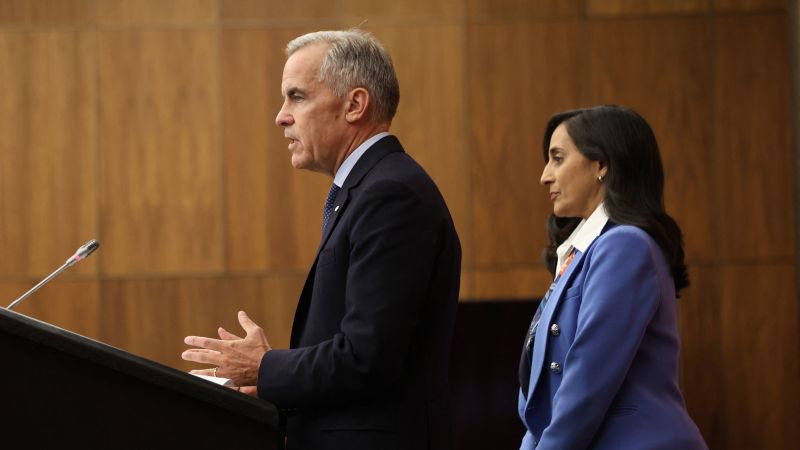
On Wednesday, Canadian Prime Minister Mark Carney announced that Canada will recognize a Palestinian state in September. This decision marks a significant shift in Canada's foreign policy and has garnered both praise and criticism from various groups.
History of Canada's Stance on Palestine
Canada has traditionally been a strong ally of Israel and has refrained from recognizing Palestine as a state. However, this stance has been challenged in recent years, with many Canadian politicians and citizens advocating for recognition of a Palestinian state.
In 2012, Canada abstained from a United Nations vote to upgrade Palestine's status to a non-member observer state. This was seen as a departure from Canada's usual pro-Israel stance.
Potential Implications of Recognition
While Canada's recognition of a Palestinian state is a symbolic gesture, it could have a significant impact on the region. It may encourage other countries to follow suit and put pressure on Israel to resume peace negotiations with Palestine.
However, there are also concerns about potential repercussions on Canada's relationship with Israel and the US. Additionally, some critics argue that this decision overlooks the ongoing conflict and human rights violations in the region.
Conclusion
Canada's announcement to recognize a Palestinian state in September is a significant development in the ongoing conflict. While it may have positive implications for
About the People Mentioned
Mark Carney
Mark Carney is Canada's 24th Prime Minister, having been elected Leader of the Liberal Party and sworn in to office in March 2025[5]. Born in Fort Smith, Northwest Territories, in 1965, Carney is the son of teachers and was raised in Edmonton, Alberta[5]. He earned a Bachelor of Economics from Harvard University in 1988, followed by a Master's degree in 1993 and a doctorate in 1995, both from Oxford University[1]. Before entering public service, Carney spent thirteen years with Goldman Sachs, working in its London, Tokyo, New York, and Toronto offices[1]. He transitioned to government in 2003 when appointed Deputy Governor of the Bank of Canada, later becoming Senior Associate Deputy Minister of Finance in 2004[1]. On February 1, 2008, he was appointed Governor of the Bank of Canada, a position he held until June 1, 2013[4]. During the 2008 financial crisis, Carney distinguished himself by reducing interest rates ahead of other nations and implementing forward guidance strategies that helped Canada weather the recession more effectively than other G7 countries[2]. His success and media accessibility made him a prominent figure in central banking circles. He chaired the Committee on the Global Financial System at the Bank for International Settlements (2010–11) and served as chairman of the Financial Stability Board (2011–18)[2]. In 2013, Carney became Governor of the Bank of England, making him the first non-British person to lead the institution since its founding in 1694[2]. He served until March 2020, applying forward guidance strategies to support the UK economy through Brexit and subsequent crises[5]. After stepping down from the Bank of England, Carney was appointed UN Special Envoy on Climate Action and Finance in 2020 and served as an informal adviser to the Canadian government during the COVID-19 pandemic[2]. In September 2024, he was tapped to lead a Liberal economic task force, ultimately leading the party to victory in the April 2025 snap election before becoming Prime Minister[2][5].
About the Organizations Mentioned
United Nations
The United Nations (UN) is a pivotal international organization established in 1945, following the devastation of World War II, with the primary goal of maintaining global peace and security, fostering international cooperation, and promoting social progress. The UN Charter, signed by 51 founding member states, including the United States, the United Kingdom, China, and the Soviet Union, laid the foundation for this ambitious endeavor[1][3]. ## History and Structure The UN was born out of the failures of its predecessor, the League of Nations, which failed to prevent World War II. Key planning meetings, such as the Dumbarton Oaks Conference in 1944, defined the UN's structure, which includes the General Assembly, the Security Council, the Economic and Social Council, the Trusteeship Council, the International Court of Justice, and the Secretariat[1][6]. The Security Council, with five permanent members (the United States, China, France, Russia, and the United Kingdom), holds significant influence due to its veto power[2]. ## Key Achievements Over the years, the UN has played a crucial role in conflict resolution, human rights advocacy, and sustainable development. Notable achievements include the establishment of the Universal Declaration of Human Rights in 1948 and the implementation of numerous peacekeeping missions worldwide[3][4]. The UN has also been instrumental in addressing global challenges such as climate change and pandemics through its various programs and agencies. ## Current Status Today, the UN comprises 193 member states, with its most recent addition being South Sudan in 2011[5]. The organization continues to evolve, addressing emerging issues like digital governance and cybersecurity. Despite challenges, the UN remains a cornerstone of international diplomacy and cooperation. ## Notable Aspects The UN's work is not limited to politics; it also impacts business and technology through initiatives that promote sustainable development and digital inclusion. Its role in setting global standards and fostering international cooperation makes it a significant player in shaping the