US Scales Back Presence at Qatar's Al Udeid Air Base Amid Iran Tensions
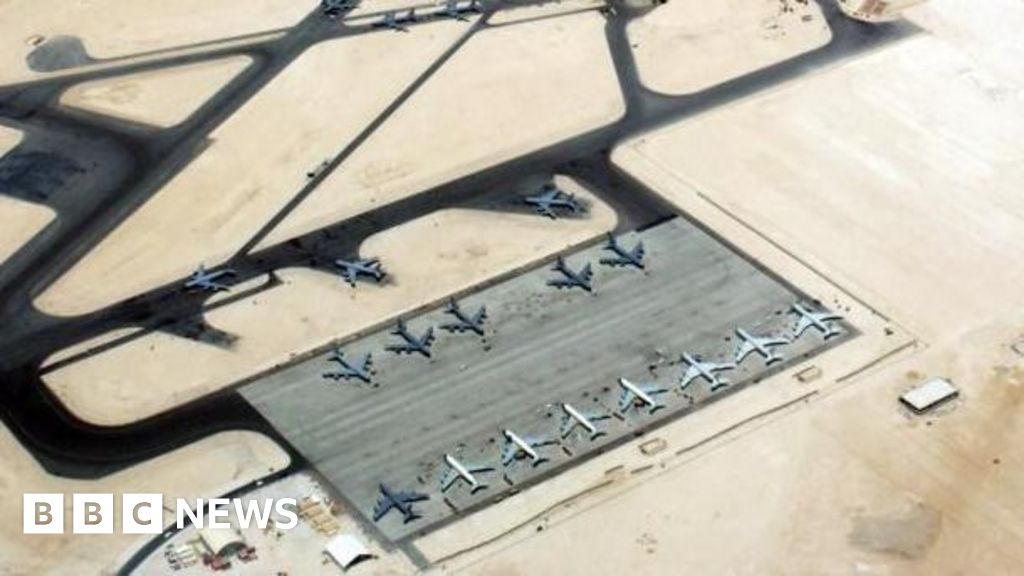
US Scales Back Presence at Qatar's Al Udeid Air Base
The United States is reducing a small number of personnel at Al Udeid Air Base in Qatar, America's largest Middle East outpost housing 8,000 to 10,000 troops, as a precautionary measure amid escalating tensions with Iran[1][2]. This forward headquarters for US Central Command comes as President Donald Trump considers military action against Tehran's brutal crackdown on anti-government protesters[1][3]. Officials emphasize the partial withdrawal protects forces while Trump weighs options, echoing a similar drawdown before last summer's Operation Midnight Hammer strikes on Iranian nuclear sites, which prompted a missile retaliation intercepted without casualties[1].
Tensions Rise with Trump's Iran Strategy
Trump's 2026 approach blends economic sanctions, tariffs on Iran traders, and assertive rhetoric, urging protesters to seize institutions and promising help is coming[2][3][4]. Iran warns against repeating past mistakes, while the UK also pulls some personnel, and Qatar prioritizes security amid regional strains[2][3]. European and Israeli officials suggest strikes could imminently occur[3].
Implications for Regional Stability
This move signals deterrence without full retreat, balancing diplomacy's uncertainty with military readiness. As Trump cuts talks until killings stop, the world watches for Iran's response, potentially reshaping Middle East dynamics and testing alliances[4]. Qatar affirms ongoing safeguards for bases and residents[1][3].
About the People Mentioned
Donald Trump
Donald John Trump, born June 14, 1946, in Queens, New York, is an American businessman, media personality, and politician. He graduated from the University of Pennsylvania’s Wharton School in 1968 with a degree in economics. In 1971, he took over his family’s real estate business, renaming it the Trump Organization, through which he expanded into building and managing skyscrapers, hotels, casinos, and golf courses. Trump gained widespread fame as the host of the reality TV show *The Apprentice* from 2004 to 2015, which helped establish his public persona as a successful entrepreneur. Trump entered politics as a Republican and was elected the 45th president of the United States, serving from 2017 to 2021. His presidency was marked by significant policy actions including tax cuts, deregulation, the appointment of three Supreme Court justices, renegotiation of trade agreements (notably replacing NAFTA with the USMCA), and a focus on immigration control including border wall expansion. He withdrew the U.S. from international agreements such as the Paris Climate Accord and the Iran nuclear deal, and engaged in a trade war with China. His administration’s response to the COVID-19 pandemic was criticized for downplaying the virus’s severity. Trump was impeached twice by the House of Representatives—first in 2019 for abuse of power and obstruction, and again in 2021 for incitement of insurrection—but was acquitted by the Senate both times. After losing the 2020 election to Joe Biden, Trump challenged the results, culminating in the January 6, 2021, Capitol riot. He remains a central figure in American politics, having won the 2024 presidential election and returned as the 47th president in 2025, continuing to promote policies aimed at economic growth, border security, and military strength[1][2][3][4].
About the Organizations Mentioned
US Central Command
**U.S. Central Command (CENTCOM)** is one of the U.S. Department of Defense's 11 unified combatant commands, directing military operations across 20 nations in the Middle East, Central Asia, South Asia, and surrounding waterways to promote U.S. interests, deter threats, and foster stability.[1][2][3][6] Established on January 1, 1983, at MacDill Air Force Base in Tampa, Florida, CENTCOM evolved from the Rapid Deployment Joint Task Force amid rising tensions like the 1979 Iranian Revolution and Soviet invasion of Afghanistan.[2][3][8] Its **area of responsibility (AOR)** spans high-stakes regions including Afghanistan, Iraq, Egypt, and the Horn of Africa, emphasizing partnerships with allies for crisis response, counterterrorism, and humanitarian aid.[1][4][7] Key achievements highlight CENTCOM's pivotal role in modern conflicts. It orchestrated **Operation Desert Storm** (1991) during the Persian Gulf War, led the 2001 defeat of the Taliban in Afghanistan post-9/11, launched **Operation Iraqi Freedom** (2003) to topple Saddam Hussein, and formed **Combined Joint Task Force - Operation Inherent Resolve** (2014) against ISIS, blending counterinsurgency with host-nation training.[2][3][9] Operations also include Horn of Africa counterterrorism since 2002, Pakistan earthquake relief (2005), and Lebanon evacuations (2006).[2][3] Currently, CENTCOM advances priorities like homeland defense, conflict deterrence, and strategic competition with China through joint exercises, intelligence via its Joint Intelligence Center, and components like U.S. Army Central and Air Forces Central.[2][3][5][8] Headquartered with specialized directorates for operations, logistics, and cyber-enabled systems, it integrates advanced tech for prepositioned supplies, airpower, and trans-regional cooperation against state and non-state threats.[3]