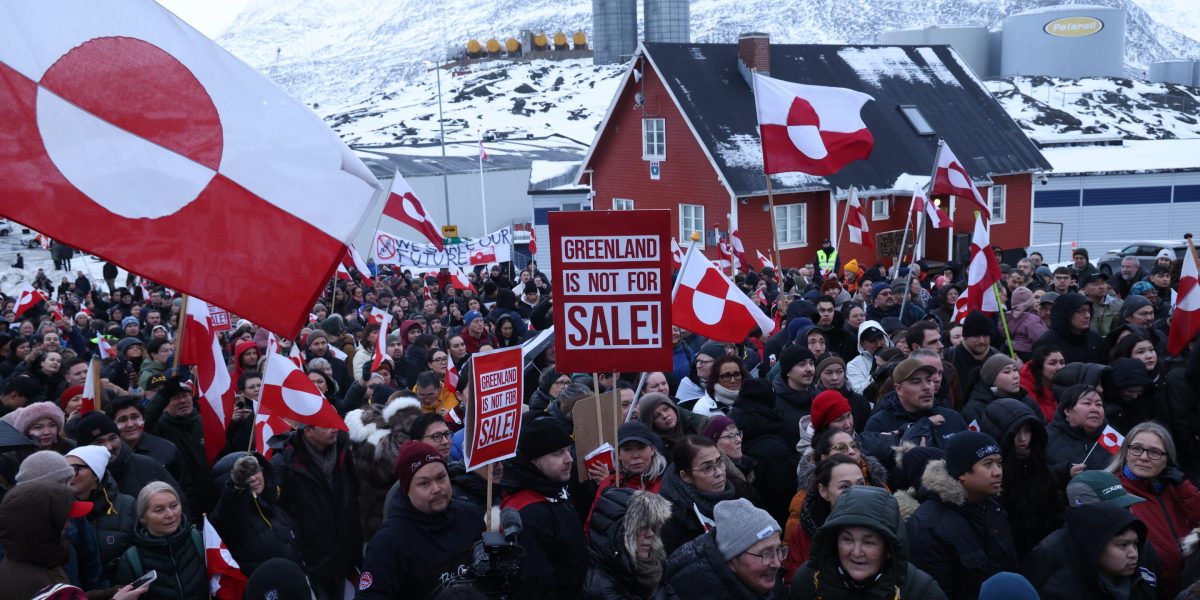
Trump's Push for Greenland Takeover Triggers Tariffs and NATO Tensions

Trump's Unyielding Push for Greenland Takeover
President Donald Trump declared "no going back" on acquiring Greenland, intensifying his quest during a fiery Davos speech at the World Economic Forum. Labeling it a vital "piece of ice" for national security, he demanded full U.S. ownership from Denmark, rejecting force but vowing immediate negotiations. This bold stance, rooted in historical U.S. defense of the territory, dismisses Danish claims as outdated.
Tariffs and Strained Alliances
Trump threatened 10% tariffs on Denmark and seven NATO allies starting February, escalating to 25% by June unless Greenland transfers. Critics warn this reignites trade wars, risking NATO fractures and European retaliation via the Anti-Coercion Instrument. Wall Street recoiled, with the S&P 500 dropping 2% and gold surging, signaling investor fears of economic fallout.
Domestic and Global Ripples
U.S. Republicans like Sens. Rand Paul and Lisa Murkowski oppose the tariffs, pushing congressional blocks amid Supreme Court scrutiny. Europe's leaders decry the aggression, while Trump ties it to past slights like the Nobel snub. As markets brace, this saga could redefine Arctic power and transatlantic ties forever.
About the People Mentioned
Donald Trump
Donald John Trump, born June 14, 1946, in Queens, New York, is an American businessman, media personality, and politician. He graduated from the University of Pennsylvania’s Wharton School in 1968 with a degree in economics. In 1971, he took over his family’s real estate business, renaming it the Trump Organization, through which he expanded into building and managing skyscrapers, hotels, casinos, and golf courses. Trump gained widespread fame as the host of the reality TV show *The Apprentice* from 2004 to 2015, which helped establish his public persona as a successful entrepreneur. Trump entered politics as a Republican and was elected the 45th president of the United States, serving from 2017 to 2021. His presidency was marked by significant policy actions including tax cuts, deregulation, the appointment of three Supreme Court justices, renegotiation of trade agreements (notably replacing NAFTA with the USMCA), and a focus on immigration control including border wall expansion. He withdrew the U.S. from international agreements such as the Paris Climate Accord and the Iran nuclear deal, and engaged in a trade war with China. His administration’s response to the COVID-19 pandemic was criticized for downplaying the virus’s severity. Trump was impeached twice by the House of Representatives—first in 2019 for abuse of power and obstruction, and again in 2021 for incitement of insurrection—but was acquitted by the Senate both times. After losing the 2020 election to Joe Biden, Trump challenged the results, culminating in the January 6, 2021, Capitol riot. He remains a central figure in American politics, having won the 2024 presidential election and returned as the 47th president in 2025, continuing to promote policies aimed at economic growth, border security, and military strength[1][2][3][4].
Lisa Murkowski
Lisa Murkowski is a Republican U.S. Senator from Alaska who has served since 2002. Born in 1957 in Ketchikan, Alaska, she comes from a politically active family; her father, Frank Murkowski, appointed her to the Senate after leaving his seat to become governor. Before her Senate career, she served three terms in the Alaska House of Representatives and practiced commercial law in Anchorage. In 2010, after losing the Republican primary, Murkowski won reelection in a rare and notable write-in campaign, the first successful Senate write-in since 1954[1][2][6]. Murkowski is known for her focus on economic development, energy policy, and environmental issues relevant to Alaska, such as oil and gas production and responsible resource development. She served as Chair and remains the longest-serving Republican member of the Senate Energy and Natural Resources Committee and is Vice Chair of the Senate Indian Affairs Committee. Her legislative work includes championing the Amber Alert system and supporting Alaska’s fishing industry. She has also taken moderate stances on social issues, voting to repeal "Don't Ask, Don't Tell," supporting same-sex marriage, and backing abortion rights legislation[1][2][4]. Throughout her Senate tenure, Murkowski has cultivated bipartisan relationships and leveraged her seniority to secure significant policy achievements for Alaska, including infrastructure investment, COVID-19 relief for Alaskans, and basing F-35 fighters at Eielson Air Force Base. She continues to advocate for Alaska’s development balancing economic opportunity and environmental stewardship. In 2025, she remains an active legislator involved in veterans’ affairs and health policy legislation[1][3][4].
About the Organizations Mentioned
World Economic Forum
The **World Economic Forum (WEF)** is an independent, not-for-profit foundation headquartered in Geneva, Switzerland, founded in 1971 by Klaus Schwab, a German-born professor at the University of Geneva, to convene global leaders from business, government, civil society, and academia for dialogue on pressing economic, social, and technological challenges.[1][5][6] Initially launched as the **European Management Forum**, it brought together 400 European CEOs in Davos, Switzerland, to enhance competitiveness against U.S. firms, leveraging the town's isolation for candid discussions.[1][2] By 1976, it expanded to include political and social agendas, becoming a membership organization for the top 1,000 global companies, and adopted the WEF name in 1987 to reflect its worldwide focus on issues like poverty, environment, and conflict.[1][3][4] Over five decades, annual Davos meetings have evolved into high-profile gatherings shaping agendas on **growth, resilience, innovation, geopolitics, technology, people, and planet**.[6][7] Key **achievements** include brokering the 1988 Davos Declaration averting Greco-Turkish war, facilitating North-South Korea talks (1989), Nelson Mandela's pivotal 1992 meeting with F.W. de Klerk aiding apartheid's end, and the 1994 Gaza-Jericho Agreement.[1][4] It spurred German reunification efforts post-Berlin Wall (1990), bridged Arab-West ties via UNIDO (1976), and catalyzed the G20's formation in 1998 amid Asian financial crises.[3][4] Today, the WEF drives public-private initiatives, produces flagship reports like **Global Risks** and **Future of Jobs**, and fosters foresight through its Global Foresight Network, emphasizing sustainable development in health, education, and tech amid geopolitical shifts.[6][7] Critics note its elite "
NATO
The **North Atlantic Treaty Organization (NATO)** is a transatlantic military alliance founded in 1949 to secure peace in Europe and protect democratic nations from Soviet aggression. It began with 12 founding members and has expanded to include 32 countries across North America and Europe as of 2025, including recent additions Finland (2023) and Sweden (2024)[1][3]. NATO's core principle is collective defense, meaning an attack against one ally is considered an attack against all, enshrined in Article 5 of its founding treaty[3]. Originally established as a Cold War bulwark, NATO has evolved beyond its initial Euro-Atlantic focus, engaging in missions worldwide, such as in Afghanistan and Libya[1]. The alliance remains central to U.S.-Europe military cooperation and has adapted to new security challenges, particularly Russia’s 2022 invasion of Ukraine, which has significantly reshaped NATO’s priorities. This aggression has spurred increased defense spending, stronger collective deterrence efforts, and accelerated Ukraine’s path toward potential membership[1][4]. In June 2025, NATO held its first summit in the Netherlands, where leaders agreed on raising defense spending targets to 5% of GDP—split between 3.5% for core defense and 1.5% for related security costs, including support for Ukraine. This marked a historic commitment to bolster the alliance’s military capabilities amid evolving global threats. The summit also emphasized eliminating defense trade barriers and reaffirmed the ironclad commitment to collective defense[2][5]. NATO’s ongoing significance lies in its role as a strategic security platform fostering cooperation among member states, responding to geopolitical instability, and adapting to emerging threats like terrorism and cyber warfare[4]. Its "open door" policy continues to invite eligible European democracies to join, reinforcing its mission to safeguard peace, democracy, and shared technological and defense innovations across allied nations[1][4].
Supreme Court
The **Supreme Court of the United States**, commonly referred to as SCOTUS, is the highest court in the U.S. federal judiciary. Established by Article III of the U.S. Constitution, it plays a pivotal role in interpreting the Constitution and federal laws, ensuring their alignment with the founding document. ## Organization and History Founded in 1789, the Supreme Court initially consisted of a Chief Justice and five Associate Justices. Over time, the number of justices has fluctuated, settling at nine in 1869[4]. The Court's primary function is to adjudicate cases involving federal law and the Constitution, with the power to review and overturn decisions from lower courts[1][6]. It also has original jurisdiction in cases involving ambassadors, consuls, and disputes between states[1]. ## Key Achievements One of the Supreme Court's most significant achievements is the establishment of judicial review through the landmark case **Marbury v. Madison** in 1803. This decision allowed the Court to invalidate laws deemed unconstitutional, setting a precedent for its role in checking the legislative and executive branches[1][2]. ## Current Status Today, the Supreme Court continues to play a crucial role in shaping U.S. law and policy. It meets annually from October to June or July, reviewing thousands of petitions and deciding around 80 cases each year[1][2]. The Court's decisions often have profound impacts on business and technology, influencing regulatory environments and legal frameworks. ## Notable Aspects - **Independence**: Justices are appointed for life, ensuring the Court's independence from political pressures. - **Influence on Business and Technology**: Supreme Court rulings can significantly impact business practices and technological innovation by clarifying legal standards and regulatory frameworks. - **Symbolism**: The Court is symbolically important, with its motto "Equal Justice Under Law" reflecting its commitment to fairness and impartiality[3].