Washington Commanders and HKS Reveal Renderings for New $3.65B RFK Stadium at DC Site
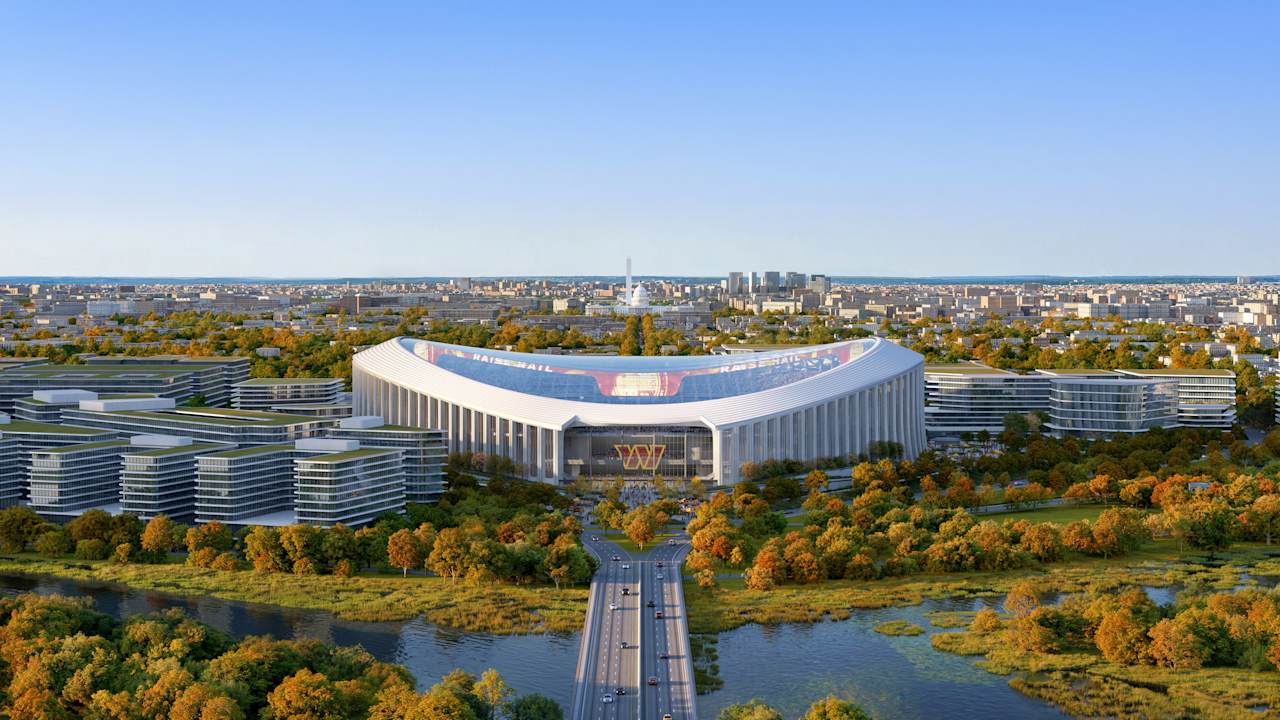
Washington Commanders and HKS Unveil Initial Renderings of New World-Class Stadium
The Washington Commanders, in partnership with renowned architects HKS, have released the first conceptual renderings of their ambitious $3.65 billion stadium at the historic RFK site in Washington, D.C. This 70,000-seat roofed venue, set to open in 2030, promises to transform the 180-acre campus into a vibrant year-round hub for sports, concerts, and community events.[1][2][5]
Striking Design Features and Historical Nod
Featuring a sculpted translucent dome that rises dramatically on the sides, the stadium offers stunning views of the U.S. Capitol and Washington Monument, aligning with the L’Enfant Plan. A continuous white colonnade facade echoes the original RFK Stadium's swooping roofline, blending classical elements with modern steel beams for an iconic skyline presence. Surrounding plazas, green spaces, and riverfront connections dedicate at least 30% to recreation, enhancing fan immersion and sustainability.[1][3][4]
A New Era for Fans and the Community
Designed to amplify crowd noise for a formidable home-field advantage, the interior maximizes energy while supporting over 200 annual events. HKS, creators of SoFi and AT&T Stadiums, integrates advanced tech and eco-friendly practices. Community input shapes the evolving project, with construction starting in 2027, positioning it for major bids like the Super Bowl.[2][5]
About the Organizations Mentioned
Washington Commanders
The Washington Commanders are a storied National Football League (NFL) franchise based in Washington, D.C., competing in the National Football Conference (NFC) East division[2][3]. The organization’s core business is professional American football, operating as one of the league’s most valuable and historically significant teams, with a large fan base and extensive media presence[1][6]. ## History Founded in 1932 as the Boston Braves, the team relocated to Washington, D.C., in 1937 and became the Redskins—a name it retained for over 80 years before controversy over cultural sensitivity led to its retirement in 2020[1][2]. After two seasons as the Washington Football Team, the franchise rebranded as the Commanders in 2022, reflecting a modernized identity amid broader social changes[1][3]. In 2023, the team was acquired by new owner Josh Harris, signaling a new era in leadership and potential strategic direction[1]. ## Key Achievements The Commanders’ legacy includes two NFL championships (1937, 1942) and three Super Bowl victories (Super Bowl XVII in 1983, XXII in 1988, and XXVI in 1992)[2][4][5]. These triumphs, especially the dominant 1991 season culminating in Super Bowl XXVI, are celebrated highlights in franchise history[5]. The team has also won multiple division titles and boasts a roster of Hall of Fame players, including Sammy Baugh, John Riggins, and Darrell Green[2][4]. Notably, the Commanders were pioneers in sports media, launching the NFL’s first marching band (1937), first radio network (1944), and first fully televised season (1950)[6]. ## Current Status and Notable Aspects Despite past glories, the Commanders have faced challenges in recent decades, with limited playoff success since the late 1990s[
HKS
**HKS, Inc.** is a leading global architecture, interior design, planning, and advisory firm headquartered in Dallas, Texas, renowned for leveraging technology to innovate within, through, and beyond the built environment.[5][6] Founded in 1939, HKS has grown into one of the largest U.S. architectural firms, employing over 1,000 people by 2015 and delivering projects valued at more than $69 billion, with $12 billion under construction at that time.[5] Its expansion accelerated post-2007 through strategic acquisitions like Hill Glazier Architects (hospitality), Earl Walls Studios (science & technology), and Maregatti Interiors (interiors), alongside new offices in cities including Miami, Shanghai, Abu Dhabi, and New Delhi.[5] In 2010, it launched the nonprofit Center for Advanced Design Research and Evaluation, and in 2013 established the HKS Laboratory for INtensive Exploration (LINE) to pioneer computational design and interdisciplinary collaboration.[1][5] HKS excels in **mission-critical facilities**, data centers for the AI era, sports venues like SoFi Stadium and U.S. Bank Stadium, and sustainable urban projects.[1][3][4] Key achievements include patented Digital Stamping and Sealing technology—licensed to ConcertVDC and used in SoFi Stadium—plus award-winning designs honored by the American Institute of Architects, Fast Company, and Prix Versailles.[1][6] The firm champions "ethical innovation," prioritizing societal well-being, R&D in hybrid energy (e.g., nuclear microreactors for off-grid data centers), flexible modular systems, and holistic design spanning city planning to micro-environments.[2][3] Today, HKS thrives as a technology-forward leader, integrating AEC tech for seamless interoperability and addressing AI-driven demands with resilient, sustainable solutions that build community trust and operational edge.[1][3] Its emphasis on breaking silos, authentic thought leadership
SoFi
SoFi—officially Social Finance, Inc.—is a leading U.S.-based fintech company that has transformed from a niche student loan refinancer into a comprehensive digital financial services platform[1][2]. Founded in 2011 by Stanford University alumni Mike Cagney, Dan Macklin, James Finnigan, and Ian Brady, SoFi initially aimed to offer better student loan options by connecting students and recent graduates with alumni and institutional investors[1][5][7]. This alumni-funded model was designed to provide lower interest rates than federal loans, leveraging data science to assess risk and minimize defaults[5][7]. Over the past decade, SoFi has rapidly expanded its product portfolio to include personal loans, mortgages, investment products, insurance, digital checking and savings accounts, and even cryptocurrency trading[1][2][3]. Its business model is direct-to-consumer, emphasizing a seamless, mobile-first experience that integrates all financial services—banking, lending, investing, and insurance—into a single digital platform[2][3]. This approach has resonated strongly with young professionals, high earners not yet wealthy (HENRYs), and tech-savvy millennials and Gen Z consumers[2][4]. The company’s proprietary risk assessment models use artificial intelligence and machine learning to evaluate factors beyond traditional credit scores, such as education and career potential, enabling more nuanced lending decisions[3]. SoFi’s growth has been marked by significant milestones: a $1 billion funding round led by SoftBank in 2015, the launch of SoFi Money (digital banking) and SoFi Invest (investment services), and the acquisition of the payments platform Galileo, which provides technology services to other fintech companies[1][3]. Today, SoFi is publicly traded and serves millions of members nationwide, with a valuation exceeding $8 billion[3]. Its app consistently receives high user ratings, reflecting a focus on member experience, community-building (including career coaching and exclusive events
AT&T
**AT&T** is a leading American multinational telecommunications conglomerate specializing in providing extensive connectivity solutions, including wireless services, fiber internet, and advanced 5G networks. Its core business focuses on delivering fast, reliable, and secure wireless and fiber broadband to consumers, businesses, and government entities. AT&T’s advanced 5G technology powers innovations across sectors such as smart homes, cities, healthcare, augmented and virtual reality, and collaborative workplace tools, positioning it at the forefront of next-generation connectivity[1]. Founded over 145 years ago, AT&T’s origins trace back to Alexander Graham Bell’s invention of the telephone, marking the company as a pioneer in communications technology. Over its history, AT&T has evolved from a traditional telephone company to a diversified technology and telecommunications giant. It maintains the largest wireless network in North America, with its mid-band 5G spectrum now covering over 280 million people, underscoring its expansive reach and leadership in wireless infrastructure[1]. Key achievements include its nationwide deployment of 5G and expansion of multi-gigabit fiber internet services, which are crucial for meeting the rapidly growing data consumption projected to be five times higher by 2025 compared to 2021. This growth is supported by significant capital investment, with $22 billion allocated for 2025 and plans to increase to $23-$24 billion annually through 2027. Financially, AT&T has demonstrated strong performance with ongoing revenue and EBITDA growth, particularly in its mobility and consumer fiber broadband segments, while executing a $20 billion share repurchase program from 2025 to 2027[2]. AT&T is also known for its innovative consumer and enterprise offerings, such as “Clutch Calls,” FirstNet Fusion for mission-critical communications, and partnerships like the one with Toyota to enhance connected vehicle services via 5G[3]. The company emphasizes diversity and community engagement, encouraging employees to bring authentic perspectives to work and positively impact society[1]. Overall, AT&