Haven-1 Assembly Begins: Pioneering Private Space Stations
Haven-1 Assembly Begins: Pioneering the Era of Commercial Space Stations
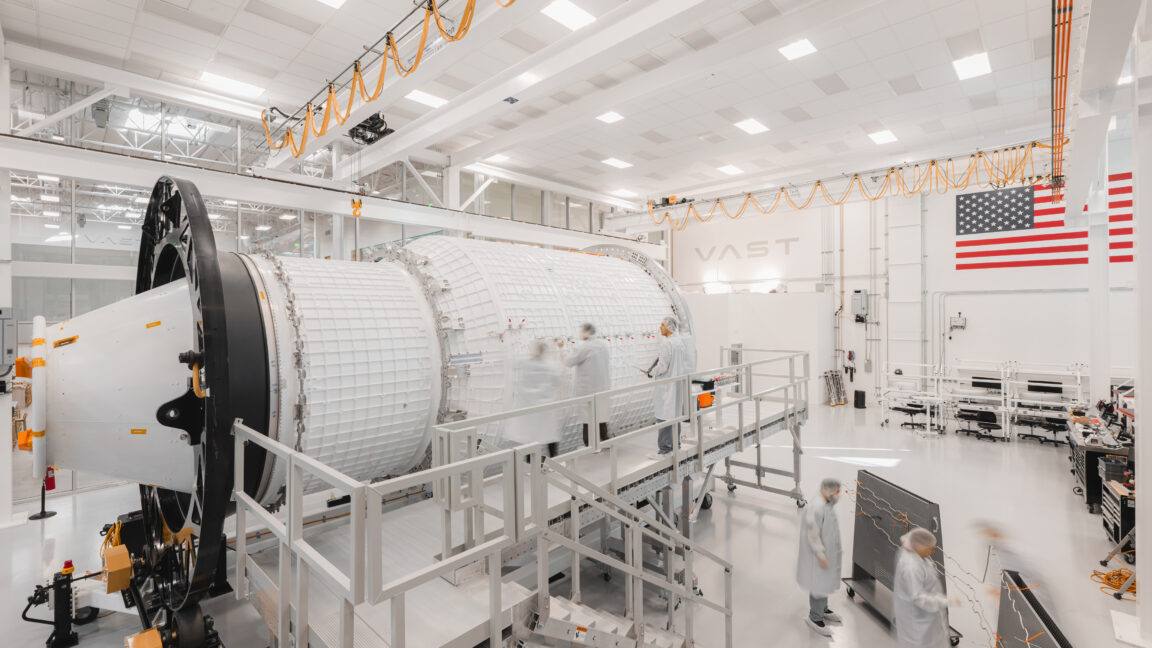
Vast has entered the integration phase for Haven-1, the world's first private space station, now in a clean room at its Long Beach headquarters. Engineers are installing pressurized fluid systems for life support, thermal control, and propulsion, followed by avionics, navigation, and crew habitation modules. This marks a milestone after 2025 successes like the Haven Demo mission and primary structure testing.[1][2]
Key Milestones and Technical Phases
The assembly unfolds in three phases: first, securing fluid infrastructure with leak tests; second, integrating the station's guidance and air revitalization systems; third, adding protective shielding, solar arrays, and interiors. Post-assembly, Haven-1 heads to NASA's Neil Armstrong Test Facility in 2026 for vibration and thermal trials before a Q1 2027 SpaceX Falcon 9 launch.[2][4]
Why Haven-1 Matters for Space Exploration
With a 10x cost reduction via in-house manufacturing, Haven-1 ensures no gap post-ISS, hosting microgravity labs for partners like Redwire. Vast urges rapid crew deployment for 30-day missions via Crew Dragon, enabling research impossible on Earth and heralding affordable private orbital outposts.[1][4]
About the People Mentioned
Neil Armstrong
Neil Armstrong (1930-2012) was an American astronaut, naval aviator, test pilot, and aeronautical engineer, best known as the first person to walk on the Moon.[1][2][4] Born on August 5, 1930, in Wapakoneta, Ohio, he earned a bachelor's degree in aeronautical engineering from Purdue University in 1955 after serving as a U.S. Navy pilot during the Korean War, where he flew 78 combat missions.[2][6][7][9] Armstrong began his civilian career as a research pilot for the National Advisory Committee for Aeronautics (NACA), predecessor to NASA, testing aircraft like the X-15 rocket plane, reaching speeds of Mach 5.74 (nearly 4,000 mph) and altitudes over 200,000 feet.[1][3][6][7] Selected in NASA's second astronaut group in 1962 as the first civilian astronaut, he commanded Gemini 8 in March 1966, achieving the first successful docking of two spacecraft in orbit with David Scott, though a thruster malfunction forced an emergency abort that he skillfully resolved.[1][2][3][4][8] His pinnacle achievement came as commander of Apollo 11 in July 1969, alongside Michael Collins and Buzz Aldrin. On July 20, Armstrong piloted the Lunar Module Eagle to a safe landing in the Sea of Tranquility, then stepped onto the lunar surface at 10:56 p.m. EDT, uttering, "That's one small step for [a] man, one giant leap for mankind." He and Aldrin spent over two hours exploring, collecting samples, and deploying experiments during the historic first manned Moon mission.[3][4][5][6] Post-NASA, Armstrong taught aerospace engineering at the University of Cincinnati, served on corporate boards, and led the 1970 investigation into NASA's Apollo 13 near-disaster. He lived privately until his death on August 25, 2012, from complications following heart surgery.[4] Armstrong's legacy endures as a symbol of human exploration, inspiring ongoing lunar programs like NASA's Artemis and private space ventures.[2][7]
About the Organizations Mentioned
Vast
**Vast (also known as Vast Space)** is a pioneering American aerospace company developing advanced space stations, including artificial gravity habitats, to enable long-term human presence in space and expand humanity beyond Earth.[5][3] Founded in 2021 by entrepreneur Jed McCaleb—co-founder of Ripple—the Long Beach, California-based firm "officially" launched in September 2022 with ambitions for the world's first artificial-gravity space stations.[5] It relocated to a 115,000-square-foot manufacturing facility in Long Beach's Globemaster Corridor in January 2023.[5] A pivotal move came in February 2023 when Vast acquired Hawthorne-based startup Launcher, integrating its E-2 engine, Orbiter payload host, and team; Launcher's founder Max Haot became Vast's CEO, bringing expertise from selling companies like Mevo and Livestream.[5][7] Key achievements include launching a pathfinder mission—a privately owned spacecraft that successfully extended its solar panel in orbit—demonstrating reliable operations ahead of competitors vying to replace the International Space Station (ISS).[3] This positions Vast for NASA's Commercial Low Earth Orbit Destinations (CLD) program Phase 2.[3][5] In February 2024, Vast partnered with AnySignal, TRL11, and Addvalue for radio frequency, inter-satellite data relay, and video tech on its Haven-1 station, while eyeing ISS private astronaut missions to challenge Axiom Space.[5] CEO Haot emphasizes in-house manufacturing and commercial revenues from microgravity drug/semiconductor production, retaining IP ownership—advantages over government platforms.[3] Currently, Vast operates as the only commercial space station company to have flown and managed its own orbital spacecraft, with transparent milestones toward crewed Haven-1 missions.[3][7] Backed by McCaleb's investment, it leverages low Earth orbit for Mars/Moon testing and commercial viabilit
NASA
The National Aeronautics and Space Administration (NASA) is the United States’ premier civil space agency, responsible for the nation’s civilian space program, aeronautics research, and aerospace technology development[1][2]. Headquartered in Washington, D.C., NASA operates ten major field centers across the country and employs nearly 18,000 civil servants, supported by an extensive network of contractors, academic institutions, and international partners[1][2]. Since its establishment in 1958, NASA has revolutionized humanity’s understanding of the cosmos, pioneered technological advancements, and shaped global space policy. ## History and Key Achievements NASA was created in response to the Soviet Union’s 1957 launch of Sputnik, with the goal of ensuring U.S. leadership in space exploration. It succeeded the National Advisory Committee for Aeronautics (NACA) and quickly became the driving force behind iconic programs such as Project Mercury (America’s first human spaceflight program), Project Gemini (which developed techniques for space rendezvous and extravehicular activity), and the Apollo program, which landed astronauts on the Moon between 1969 and 1972[1]. The agency also developed the Space Shuttle, the world’s first reusable spacecraft, and built the International Space Station (ISS), a symbol of international collaboration and scientific research[1][5]. NASA’s robotic exploration has been equally transformative, with over 1,000 uncrewed missions investigating Earth, the Moon, Mars, and beyond. The agency’s fleet of observatories—including the Hubble Space Telescope and the James Webb Space Telescope—has provided unprecedented views of the universe, from the birth of stars to the detection of exoplanets[1]. The Perseverance rover is currently searching for signs of ancient life on Mars, while New Horizons explored Pluto and the outer solar system[1]. ## Current Status and Notable Aspects Today, NASA is advancing the Artemis program, aiming to return human
Redwire
**Redwire Corporation (NYSE: RDW)** is a leading American aerospace manufacturer and space infrastructure technology company headquartered in Jacksonville, Florida, specializing in advanced hardware, digital engineering, autonomous systems, and multi-domain operations for space and defense.[2][3][5] Formed on June 1, 2020, by private equity firm AE Industrial Partners through the merger of Adcole Space (experts in sun sensors and spacecraft components) and Deep Space Systems, Redwire rapidly expanded via acquisitions: Made In Space for 3D printing (June 2020), Edge Autonomy for $925 million (June 2025, later integrated under Redwire branding), and Hera Systems to broaden uncrewed aerial systems and defense tech.[1][3][4][6] It went public in January 2021, blending "Heritage plus Innovation" to deliver reliable components with cutting-edge developments.[1][2] Redwire designs, manufactures, and tests mission-critical technologies like star trackers, solar arrays (e.g., Roll-Out Solar Array or ROSA for lunar Gateway), deployable structures, avionics, sensors, in-space manufacturing (e.g., Mason tech, PIL-BOX for pharmaceuticals), cloud-based simulations, and AI-driven platforms. With ~1,300 employees across U.S. and Europe sites, it serves government (NASA, DoD), commercial, and research clients, enabling lunar missions (SentinelCam), microgravity biotech (SpaceMD launched August 2025), and ISR for warfighters.[1][2][3][4][6][7] Key achievements include ROSA's successful lunar test, in-orbit servicing leadership, and strategic pivots like sunsetting Edge Autonomy for unified Space (spacecraft, infrastructure, SpaceMD) and Defense Tech segments, optimizing growth in booming markets.[4][6] Currently thriving with innovation roadmaps, Redwire accelerates humanity's space expansion—powering exploration, manufacturing off-Earth
SpaceX
SpaceX is a private aerospace manufacturer and space transportation company founded in 2002 by Elon Musk with the mission to revolutionize space technology and enable human life to become multiplanetary[3]. It designs, manufactures, and launches advanced rockets and spacecraft, pioneering reusable rocket technology to dramatically reduce the cost of access to space. One of SpaceX’s key achievements includes the development and operational success of the Falcon 9 and Falcon Heavy rockets, both featuring reusable first-stage boosters. This reusability has significantly lowered launch costs and increased reliability, enabling frequent commercial, scientific, and government missions. SpaceX has launched over 95 national security missions with these rockets, demonstrating maturity and trust from the U.S. Space Force and other agencies[2]. Another major milestone is the Starlink satellite constellation, with nearly 6,900 satellites currently in orbit as of 2025. Starlink aims to provide global broadband internet service, especially in underserved regions, making it one of the largest satellite constellations in history[1]. This ambitious project also serves as a revenue stream to fund SpaceX’s broader goals. Looking ahead, SpaceX is developing Starship, a next-generation fully and rapidly reusable super heavy-lift launch system designed to carry large payloads and humans to the Moon, Mars, and beyond. Elon Musk envisions Starship enabling mass transport to Mars, with the potential to launch multiple times a day, dramatically increasing total mass sent to orbit annually, far surpassing all previous space launch capabilities combined[1][2]. Pending environmental reviews, Starship’s first launch from Florida’s LC-39A is planned for late 2025[2]. Despite these advances, SpaceX remains privately held, with limited public insight into its financial health. Questions persist around the profitability of Falcon launches, Starlink operations, and future Starship missions, especially given the enormous funding required for Mars colonization[1]. Nonetheless, SpaceX continues to inspire both enthusiasm and debate in the business and technology