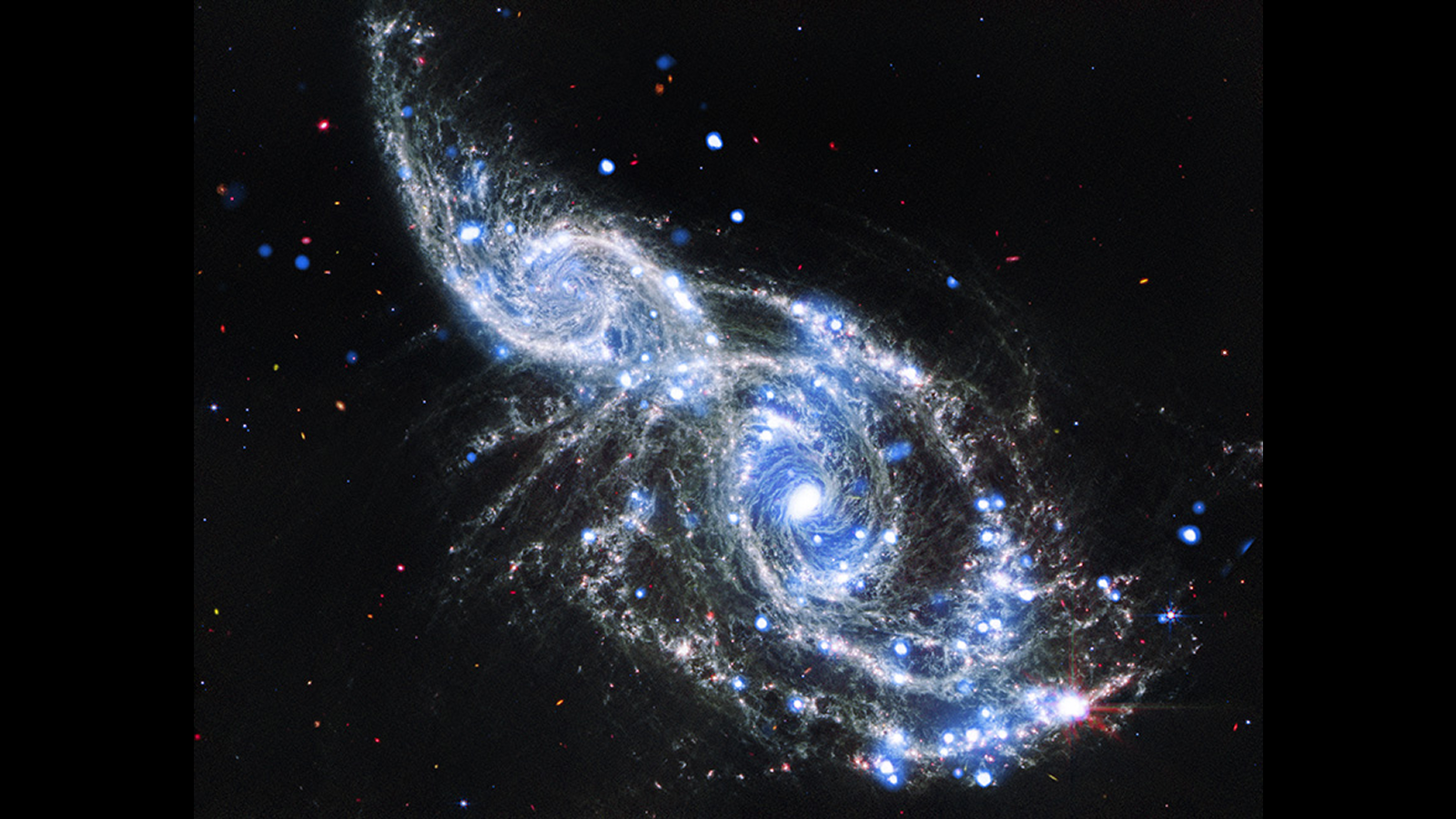
Planar Dark Matter Sheet Explains Andromeda's Movement Toward the Milky Way

About the People Mentioned
Perplexity
**Perplexity AI** is an American software company founded in August 2022 by engineers Aravind Srinivas (CEO), Denis Yarats (CTO), Johnny Ho (Chief Strategy Officer), and Andy Konwinski, specializing in an AI-powered web search engine that delivers synthesized responses with real-time citations from internet sources.[1][2][3] The founders drew from experiences at OpenAI, Meta, Quora, and Databricks to address limitations in traditional search and early AI chatbots like ChatGPT, which often lacked verifiable sources.[1][2][3] Perplexity launched its flagship conversational "answer engine" on December 7, 2022, initially as a free public beta using OpenAI's GPT-3.5 and Microsoft Bing, later incorporating proprietary models based on Mistral-7B and LLaMA-2.[1][2][4] It pivoted from an earlier tool, Bird SQL, after Twitter's API changes in February 2023, focusing on direct answers over links.[1][2] Key achievements include rapid growth: 2 million monthly active users by March 2023, 10 million by January 2024, and 780 million queries processed monthly by 2025.[1][2][5] Funding milestones propelled valuations from $1 billion in April 2024 (after $165 million raised) to $14 billion in June 2025 ($500 million round), reaching $20 billion by September 2025.[3] Backed by investors like Jeff Bezos, Nvidia, and Shopify's Tobi Lutke, it introduced mobile apps, a Pro subscription, Chrome extension, and a publishers' revenue-sharing program in July 2024.[1][3][4] Recent events underscore ambition: In January 2025, Perplexity proposed merging with TikTok's U.S. operations ahead of a ban; in August 2025, it bid $34.5 billion for Google Chrome to address antitrust issues.[3] Today, Perplexity remains a leading AI search disruptor, blending LLMs like GPT-4, Claude, and Mistral for personalized, ad-free research, challenging Google with over 10 million users and unicorn status in under two years.[2][3][4][5] (Word count: 298)
About the Organizations Mentioned
University of Groningen
The **University of Groningen (RUG)**, founded in 1614 in the Netherlands, is a leading public research university renowned for its innovation in education and science, particularly in energy, healthy ageing, and sustainable society—key areas intersecting business and technology[4][5]. Established by the city of Groningen and surrounding regions with initial faculties in Theology, Law, Medicine, and Philosophy, it began modestly with 82 students (30% international) and six professors, building on the city's Latin school tradition that drew scholars from Europe[1][3][6][8]. Its history reflects resilience and growth: surviving Napoleonic threats as a "branch" of Paris's Imperial University, it was renamed Rijksuniversiteit Groningen in 1877 under the Higher Education Act, shifting to Dutch instruction, emphasizing research, and expanding labs in physics, medicine, and exact sciences[2][3][7]. Women gained admission in 1871, with Aletta Jacobs as the first female student[3][5]. Student numbers surged from 611 in 1914 to 1,000 by 1924, reaching 20,000 by 1994 despite wartime dips[2][3]. **Key achievements** include four Nobel laureates—Frits Zernike (Physics, 1953, phase-contrast microscope revolutionizing biology), Ben Feringa (Chemistry, 2016), and others—plus nine Spinoza Prize and one Stevin Prize winners[1][2][3][5][9]. Alumni feature the first ECB president, NATO secretary-general, Dutch astronaut, and royals[3][5]. Today, as the Netherlands' third-largest university, RUG hosts **36,420 students** (over 9,000 international from 127 countries) across 11 faculties, nine graduate schools, 27 research institutes, and 175+ programs in vibrant Groningen and Leeuwar