Revolutionary Discovery in Galaxy VV 340a

Revolutionary Discovery in Galaxy VV 340a
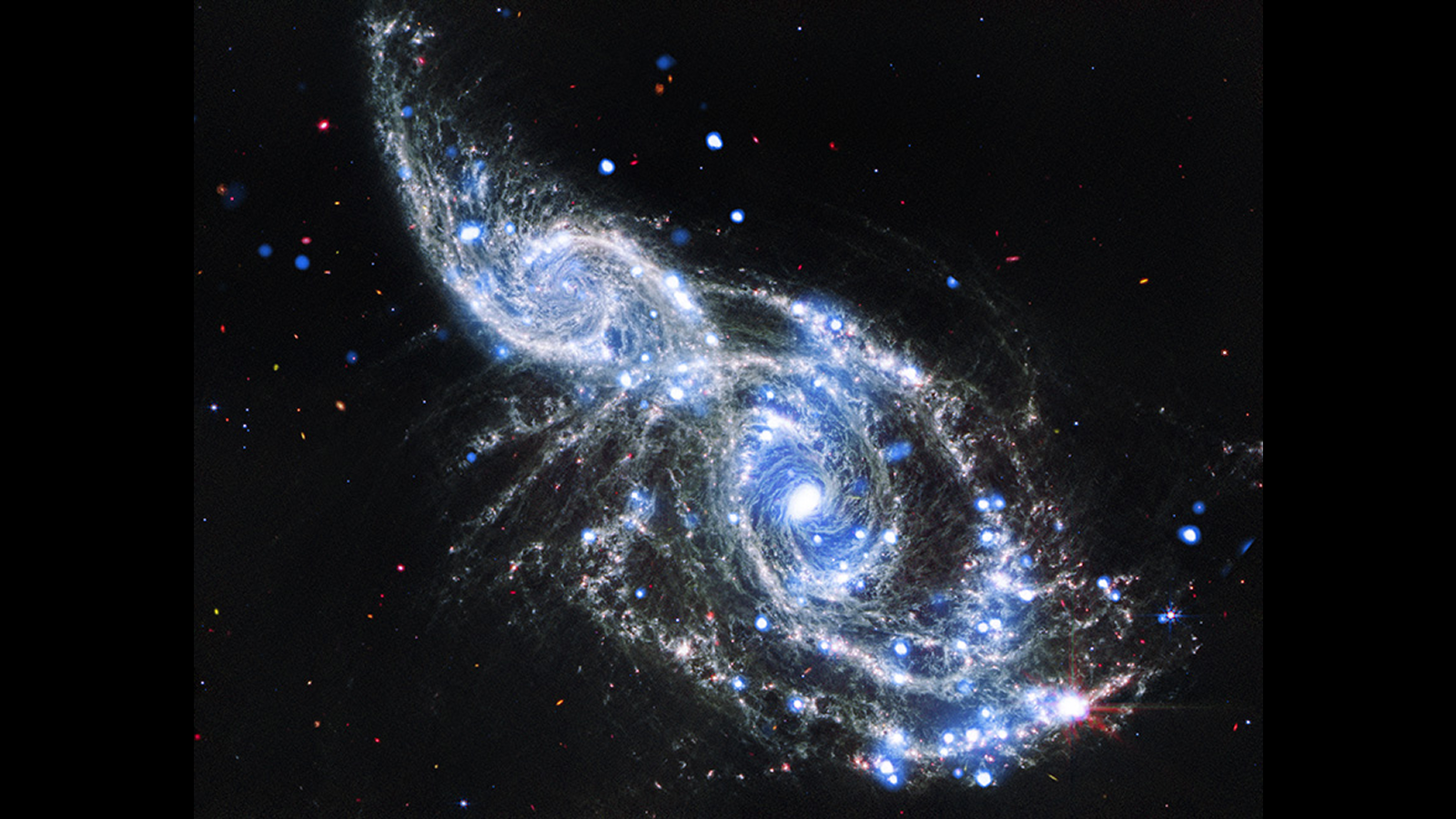
Astronomers have made a groundbreaking discovery using the W. M. Keck Observatory in Hawaii, identifying the largest and most extended stream of super-heated gas ever observed flowing from a nearby galaxy[1]. This remarkable finding in galaxy VV 340a reveals energized gas structures stretching up to 20,000 light-years from the galaxy's center, far exceeding previous observations[1]. The discovery provides compelling evidence that supermassive black holes can dramatically reshape their host galaxies far beyond their cores[1].
The Wobbling Jet Phenomenon
Using radio data from the Karl G. Jansky Very Large Array, researchers detected a pair of plasma jets that twist into a helical, S-shaped pattern as they move outward[1]. This rare phenomenon, called jet precession, represents the first observation of a precessing kiloparsec-scale radio jet in a disk galaxy[1]. The jets strip gas at a rate equivalent to forming nearly 20 suns yearly, dramatically suppressing future star formation[1].
Unexpected Location
Most surprising is that this powerful activity occurs in VV 340a, a relatively young, star-forming spiral galaxy still merging with another galaxy[2]. Powerful precessing jets typically appear only in old elliptical galaxies, making this discovery fundamentally reshape our understanding of galactic evolution[2].
```About the Organizations Mentioned
W. M. Keck Observatory
W. M. Keck Observatory is a leading astronomical research facility whose twin 10‑meter telescopes on Maunakea, Hawaiʻi, are among the **world’s most scientifically productive optical and infrared instruments**.[1][2] For business and technology readers, Keck is a flagship example of high‑performance engineering, advanced optics, and public–private partnership in big science. The observatory operates two segmented‑mirror telescopes, each composed of **36 hexagonal segments** that behave as a single precision mirror—an innovation that marked a major break from traditional monolithic designs and helped set the template for today’s largest telescopes.[1][2][4] Each telescope weighs about **300 tons**, stands roughly eight stories tall, and is controlled with nanometer‑scale precision, enabling extremely fine measurements of light from distant cosmic objects.[2][3] Keck I began scientific operations in 1993, followed by Keck II in 1996, and together they quickly became the largest optical reflecting telescopes in the world at the time.[1] The observatory is governed by the **California Association for Research in Astronomy (CARA)**, with core institutional partners including Caltech and the University of California, and liaison roles for NASA and the W. M. Keck Foundation.[2] It operates as a **501(c)(3) nonprofit**, funded by a mix of competitive public grants and private philanthropy—an organizational model closely watched in large‑scale research infrastructure.[2] Scientifically, Keck has contributed to breakthroughs in **exoplanet discovery**, observations that helped confirm the **Big Bang** framework, precision studies of the **Milky Way’s central black hole**, and key data underpinning the discovery of **dark energy**, which was later recognized with a Nobel Prize.[1][7][9] Its high‑resolution spectrometers and adaptive optics systems—using powerful lasers to create artificial guide
Karl G. Jansky Very Large Array
The **Karl G. Jansky Very Large Array (VLA)** is one of the world’s premier radio astronomy observatories, operated by the U.S. National Science Foundation’s National Radio Astronomy Observatory (NRAO). It is not a company but a large-scale scientific infrastructure that nonetheless showcases cutting-edge technology, data systems and long-horizon capital planning attractive to business and tech readers.[2][5] Located on the Plains of San Agustin near Socorro, New Mexico, the VLA consists of **27 movable 25‑meter antennas** arranged in a Y-shaped pattern on railroad tracks, allowing the array to simulate a single giant telescope up to 36 km (22 miles) across.[2][3][5] By combining signals from all dishes using interferometry, it delivers exceptional resolution in centimeter‑wavelength radio light, making it a global workhorse for high-impact astrophysics.[2][3] Conceived in the 1960s and dedicated in 1980, the VLA has supported more than **11,000 observing projects**, produced thousands of papers and underpinned over 200 Ph.D. theses, influencing nearly every branch of astronomy.[1][3] Its discoveries span **black holes, protoplanetary disks, magnetic filaments at the Milky Way’s center, cosmological parameters, and the physics of radio emission** in galaxies and jets.[1][3] A major decade‑long Expanded VLA (EVLA) upgrade replaced 1970s electronics with state‑of‑the‑art systems, boosting capability by factors up to 8,000 and prompting its 2012 renaming in honor of radio astronomy pioneer Karl G. Jansky.[2] Currently, the VLA remains a heavily subscribed open-access facility, supporting flagship projects such as the **VLA Sky Survey (VLASS)**, a multi‑epoch, all‑sky radio survey using ~5,500