Republicans Gear Up for DHS Funding Punt as Immigration Debates Intensify

Republicans Gear Up for DHS Funding Punt
As midnight Friday looms, Republicans are bracing for a short-term funding extension for the Department of Homeland Security, with full-year reforms looking increasingly improbable amid partisan clashes. Top immigration officials testified before the House Homeland Security Committee today, highlighting oversight demands as the February 13 deadline nears.[1][6]
Standoff Over ICE Reforms Intensifies
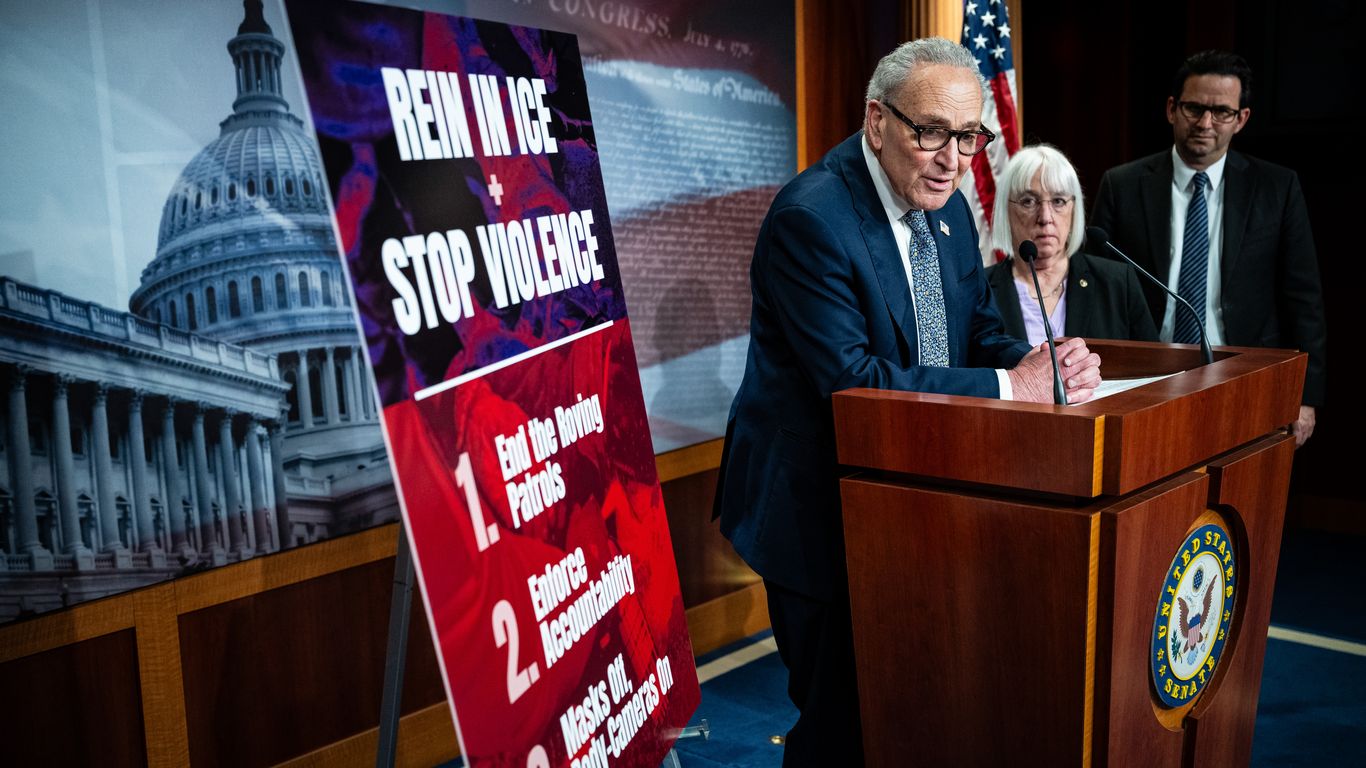
Democrats, led by Hakeem Jeffries and Chuck Schumer, rejected a Republican proposal Monday, insisting on Immigration and Customs Enforcement accountability measures following recent controversies like deadly agent-involved shootings.[5] A prior two-week stopgap, signed by President Trump, averted a full shutdown but bought scant time for negotiations on enforcement policies.[2][4] Senate Majority Leader John Thune eyes another temporary bill to avoid lapse.[1]
What Lies Ahead for DHS and Beyond
Without agreement, agencies like TSA and FEMA risk disruptions post-February 13, though core immigration operations persist via prior funds.[5] This punt underscores deep immigration divides, potentially delaying comprehensive DHS overhaul and fueling ongoing political tension.[7]
About the People Mentioned
John Thune
John Thune is a U.S. Senator from South Dakota and the Senate Majority Leader as of 2025. Born in 1961 and raised in Murdo, South Dakota, Thune's interest in politics began early, influenced by a chance meeting with then-Rep. Jim Abdnor. He earned an undergraduate degree from Biola University and an MBA from the University of South Dakota. Early in his career, he worked for Senator Abdnor and the Small Business Administration under President Ronald Reagan. Returning to South Dakota in 1989, he held leadership roles including executive director of the state Republican Party and director of the State Railroad Division. Thune was first elected to the U.S. House of Representatives in 1996, serving three terms and gaining recognition for securing funding for state projects and advocating for smaller government and tax cuts. After narrowly losing a 2002 Senate race, he won a U.S. Senate seat in 2004 by defeating then-Senate Democratic Leader Tom Daschle, marking a historic upset. He has been reelected multiple times, including an unopposed Senate race in 2010. Throughout his Senate career, Thune has served on key committees such as Agriculture, Commerce, and Finance, and has held significant leadership positions including Senate Republican Whip and Chairman of the Senate Republican Conference. Known as a conservative Republican, he has focused on energy, agriculture, tax reform, and social issues. Notably, he introduced legislation to limit EPA regulatory authority and to repeal the federal estate tax. In 2024, Thune was elected Senate Majority Leader, assuming the role in 2025. He resides in Sioux Falls with his wife Kimberley; they have two daughters and six grandchildren. Outside politics, he enjoys pheasant hunting, running, and spending time with family[1][2][4][5][6].
About the Organizations Mentioned
Department of Homeland Security
The **Department of Homeland Security (DHS)** is a U.S. federal agency established in response to the 9/11 terrorist attacks to safeguard the nation from a wide range of threats including terrorism, natural disasters, cyberattacks, and border security challenges. Its core mission is to protect the American people, critical infrastructure, and uphold national security by coordinating efforts across government and private sectors. DHS oversees immigration enforcement, cybersecurity, emergency response, and counterterrorism initiatives. Formed in 2002, DHS consolidated 22 federal agencies to create a unified structure for domestic security. Its key components include the U.S. Customs and Border Protection, the Federal Emergency Management Agency (FEMA), and the Transportation Security Administration (TSA). Over the years, DHS has played a critical role in preventing terrorist attacks, enhancing airport security, responding to natural disasters like hurricanes and pandemics, and advancing cybersecurity protections for government and private sector networks. In recent years, DHS has shifted focus towards emerging threats such as unmanned drone attacks on infrastructure, cyber intrusions into financial and critical systems, and disruptions to supply chains. Strategic visions for 2025 and beyond emphasize technological innovation, integration of intelligence, and public-private partnerships to address these complex challenges. The agency’s budget reflects its broad mandate, with over $400 billion allocated for fiscal year 2025, underscoring its significant role in national security and emergency preparedness. Notably, DHS has faced scrutiny and calls for reform, especially regarding immigration enforcement and internal mission clarity. Recent directives have expanded immigration enforcement powers to other federal law enforcement agencies, reflecting policy shifts under different administrations focused on border security. For business and technology sectors, DHS represents a major government player driving innovation in cybersecurity, disaster response technology, and infrastructure protection, while navigating evolving threats in a complex geopolitical landscape. Its ongoing modernization efforts aim to enhance resilience and adapt to future security challenges.
House Homeland Security Committee
The **U.S. House Committee on Homeland Security** is a standing committee of the House of Representatives that oversees national security policy, legislates on homeland threats, and provides rigorous oversight of the Department of Homeland Security (DHS).[1][2][4] Established as a select committee in 2002 following the 9/11 attacks, it became permanent on January 4, 2005, to centralize fragmented oversight previously spread across 13 committees and over 60 subcommittees, ensuring focused scrutiny of DHS agencies like Customs and Border Protection, TSA, FEMA, ICE, and the Coast Guard.[1][5][7][8] Its core mandate under House Rule X spans **border and port security**, **cybersecurity**, **transportation security**, **counterterrorism**, **disaster preparedness**, intelligence integration, and research and development—critical for business leaders navigating supply chains, tech infrastructure, and data protection.[2][4][5][6] The committee holds hearings, investigates threats (e.g., narcotics trafficking akin to terrorism, disinformation boards), subpoenas witnesses, and reviews interagency coordination, meeting monthly with strict quorum rules for actions like executive sessions.[1][3] A landmark **achievement** was its 107th Congress role in crafting H.R. 5005, creating DHS in 2002 via unanimous House approval, streamlining post-9/11 defenses.[1] Bipartisanship shines through near-unanimous bill passage, with leadership flipping between Reps. King and Thompson amid party shifts (e.g., Thompson chaired in 110th and 116th Congresses).[1] Today, under Chairman Andrew Garbarino, it operates via subcommittees like **Cybersecurity and Infrastructure Protection**, **Border Security and Enforcement**, and **Emergency Management and Technology**, tackling AI-driven threats, supply chain vulnerabilities, and event security—vital for tech firms and global trade.[6] In the 118th Congress
Immigration and Customs Enforcement
**Immigration and Customs Enforcement (ICE)** is a federal law enforcement agency under the U.S. Department of Homeland Security (DHS). Established by the Homeland Security Act of 2002, ICE was created in response to the 9/11 attacks to enhance national security and protect public safety. The agency's primary mission is to enforce federal laws related to customs, trade, and immigration, focusing on cross-border crime and illegal immigration[1][2][3]. **History and Structure:** ICE was formed by merging the U.S. Customs Service and the Immigration and Naturalization Service. It operates with over 20,000 staff across more than 400 global offices, with an annual budget of approximately $8 billion[3]. The agency is structured into several key directorates, including **Enforcement and Removal Operations (ERO)**, which handles immigrant detention and deportation, and **Homeland Security Investigations (HSI)**, which investigates transnational crimes[1][2]. **Key Functions and Achievements:** ICE is known for its immigration enforcement efforts, particularly in interior regions of the U.S. It conducts investigations into human trafficking, terrorism, and other transnational crimes. Despite controversy over policies like family separation and detention conditions, ICE has made significant strides in combating illegal activities and protecting national security[4][6]. **Current Status and Notable Aspects:** Today, ICE continues to face challenges and controversy, particularly regarding its enforcement practices and impact on immigrant communities. The agency's actions can have profound effects on local economies and social services, as fear of ICE may deter undocumented immigrants from accessing essential services[6]. Despite these challenges, ICE remains a crucial component of U.S. immigration policy, working to balance enforcement with humanitarian concerns.
Transportation Security Administration
The **Transportation Security Administration (TSA)** is a U.S. federal agency under the Department of Homeland Security responsible for safeguarding the nation’s transportation systems, primarily focusing on airport security and preventing aircraft hijackings. Established in response to the September 11, 2001 terrorist attacks, the TSA was created to consolidate and enhance air travel security through federal oversight and coordinated policies[1]. The TSA’s core functions include screening passengers and their baggage at over 450 airports nationwide using technologies such as full-body scanners, explosives detection, and pat-downs. It also deploys specialized personnel like Transportation Security Officers (TSOs), explosives detection dog handlers, bomb technicians, and armed Federal Air Marshals on aircraft to protect travelers[1][2][3]. Beyond aviation, the TSA develops security policies for other transport sectors including highways, railroads, buses, mass transit, ports, and pipelines, working in partnership with federal, state, and local agencies[1]. Since its inception, the TSA has evolved into a large organization with a budget of approximately $9.7 billion (FY 2023) and employing over 47,000 security personnel[1]. It manages a complex balance between rigorous security measures and maintaining efficient passenger flow, often employing advanced technology and training to detect threats while minimizing inconvenience[2][3]. The agency values integrity, respect, and commitment, emphasizing a professional workforce engaged in counterterrorism efforts to ensure freedom of movement for people and commerce[3][4]. Notable aspects of the TSA include its pioneering role in airport security innovation post-9/11, its expansive nationwide presence, and ongoing challenges such as public scrutiny over privacy, effectiveness, and occasional controversies related to security procedures. Despite this, the TSA remains a central pillar in the U.S. transportation security framework, continuously adapting to emerging threats and technologies to protect millions of travelers daily[1][3][5].
Federal Emergency Management Agency
## Overview The **Federal Emergency Management Agency (FEMA)** is a cornerstone of U.S. disaster response and preparedness, operating under the Department of Homeland Security. Its primary mission is to coordinate the federal government’s response to disasters that overwhelm local and state resources, ensuring rapid recovery and effective mitigation of future risks[1][3]. FEMA’s scope spans both natural disasters—such as hurricanes, floods, and wildfires—and man-made incidents, including acts of terrorism[3]. ## History FEMA was established in 1979 by President Jimmy Carter through a presidential reorganization plan, consolidating various federal disaster-response activities into a single agency[1]. This move was designed to streamline the nation’s approach to emergency management and civil defense. Over time, FEMA’s responsibilities expanded, and it became part of the Department of Homeland Security in 2003, reflecting a post-9/11 focus on national security and resilience[1]. ## What FEMA Does FEMA’s operations are comprehensive, covering every phase of disaster management: **preparedness, prevention, mitigation, response, and recovery**[3][4]. Before disasters strike, FEMA engages in public education, community planning, and training to reduce vulnerabilities. When disasters occur, the agency provides immediate assistance—funding, deploying personnel, and supplying critical resources—to individuals, state and local governments, and nonprofits[2]. FEMA also administers programs for rebuilding infrastructure, offering low-interest loans and hazard mitigation grants[1][5]. ## Key Achievements FEMA’s achievements include major responses to catastrophic events like Hurricane Katrina (2005), Superstorm Sandy (2012), and, more recently, Hurricanes Helene and Milton in 2024. During the latter, FEMA approved over $4.3 billion in aid and mobilized thousands of federal responders, demonstrating its capacity for large-scale coordination[2]. The agency has also been instrumental in developing national standards for emergency management