Carney Stands Firm as Trump Call Tests Canada-US Relations
#canada_us_relations #tariffs #diplomacy #trade_diversification #geopolitics
Carney Stands Firm After Tense Trump Call
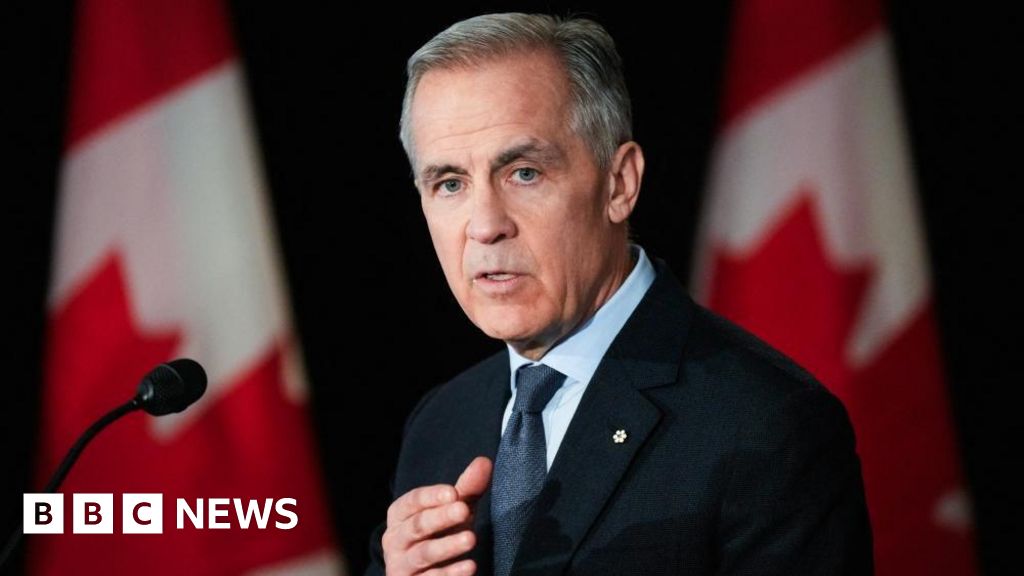
Canadian Prime Minister Mark Carney firmly denied US Treasury Secretary Scott Bessent's claim that he backtracked on his provocative Davos speech during a recent phone call with President Donald Trump. The conversation followed Trump's threats of 100% tariffs on Canada and sharp rebukes over Carney's remarks urging middle powers to challenge American hegemony. Carney emphasized that Canada recognized shifts in US trade policy early and is diversifying ties overseas while boosting domestic investments, all while open to USMCA adjustments.[2][3]
Clashing Accounts Fuel Political Fire
Bessent, fresh from the Oval Office, told Fox News that Carney aggressively softened his stance, stressing Canada's heavy reliance on north-south trade over east-west links. Yet Carney countered that it was a constructive dialogue, with Trump grasping Canada's strategic responses. His office skipped the usual readout, prompting Canadian Conservatives to demand transparency amid competing narratives.[1][2]
Implications for Canada-US Relations
Trump's jabs, including mocking Carney as 'governor' and disinviting him from a so-called 'Board of Peace,' plus China deal criticisms, underscore fraying ties. As Carney pushes back against perceptions of overdependence, this spat highlights risks to bilateral trade and Canada's pivot toward global diversification for economic resilience.[3]
About the People Mentioned
Mark Carney
Mark Carney is Canada's 24th Prime Minister, having been elected Leader of the Liberal Party and sworn in to office in March 2025[5]. Born in Fort Smith, Northwest Territories, in 1965, Carney is the son of teachers and was raised in Edmonton, Alberta[5]. He earned a Bachelor of Economics from Harvard University in 1988, followed by a Master's degree in 1993 and a doctorate in 1995, both from Oxford University[1]. Before entering public service, Carney spent thirteen years with Goldman Sachs, working in its London, Tokyo, New York, and Toronto offices[1]. He transitioned to government in 2003 when appointed Deputy Governor of the Bank of Canada, later becoming Senior Associate Deputy Minister of Finance in 2004[1]. On February 1, 2008, he was appointed Governor of the Bank of Canada, a position he held until June 1, 2013[4]. During the 2008 financial crisis, Carney distinguished himself by reducing interest rates ahead of other nations and implementing forward guidance strategies that helped Canada weather the recession more effectively than other G7 countries[2]. His success and media accessibility made him a prominent figure in central banking circles. He chaired the Committee on the Global Financial System at the Bank for International Settlements (2010–11) and served as chairman of the Financial Stability Board (2011–18)[2]. In 2013, Carney became Governor of the Bank of England, making him the first non-British person to lead the institution since its founding in 1694[2]. He served until March 2020, applying forward guidance strategies to support the UK economy through Brexit and subsequent crises[5]. After stepping down from the Bank of England, Carney was appointed UN Special Envoy on Climate Action and Finance in 2020 and served as an informal adviser to the Canadian government during the COVID-19 pandemic[2]. In September 2024, he was tapped to lead a Liberal economic task force, ultimately leading the party to victory in the April 2025 snap election before becoming Prime Minister[2][5].
Scott Bessent
Scott Bessent is an American government official and former hedge fund manager, currently serving as the 79th United States Secretary of the Treasury since January 28, 2025. Born on August 21, 1962, in South Carolina, Bessent graduated from Yale College with a degree in political science in 1984. Initially interested in journalism, he shifted to finance after missing out on a role at the Yale Daily News. He began his career with an internship under Jim Rogers, George Soros's first partner. Bessent's career in finance is marked by significant achievements. He was a key figure at Soros Fund Management, where he managed the London office and played a crucial role in profiting from major currency bets, notably earning $1 billion during the British Pound sterling crisis on Black Wednesday and $1.2 billion betting against the Japanese yen in 2013. After leaving Soros in 2015, he founded Key Square Capital Management, a global macro investment firm. Bessent also taught economic history as an adjunct professor at Yale University. In politics, Bessent has been involved as an economic advisor and major donor to the Donald Trump 2024 presidential campaign. His nomination as Treasury Secretary was announced by President-elect Trump on November 22, 2024, and he was confirmed by the Senate on January 27, 2025. As Secretary, Bessent focuses on maintaining economic strength, promoting growth, and enhancing national security through financial management. He is noted for his views on globalization and tariffs, advocating for updates to the international trading system to address inequality and economic disparities. Bessent's appointment marks him as the second openly gay man to serve in a U.S. Cabinet and the highest-ranking openly LGBT person in the federal government. His tenure as Treasury Secretary is expected to shape U.S. economic policies, particularly under the Trump administration's agenda.
Donald Trump
Donald John Trump, born June 14, 1946, in Queens, New York, is an American businessman, media personality, and politician. He graduated from the University of Pennsylvania’s Wharton School in 1968 with a degree in economics. In 1971, he took over his family’s real estate business, renaming it the Trump Organization, through which he expanded into building and managing skyscrapers, hotels, casinos, and golf courses. Trump gained widespread fame as the host of the reality TV show *The Apprentice* from 2004 to 2015, which helped establish his public persona as a successful entrepreneur. Trump entered politics as a Republican and was elected the 45th president of the United States, serving from 2017 to 2021. His presidency was marked by significant policy actions including tax cuts, deregulation, the appointment of three Supreme Court justices, renegotiation of trade agreements (notably replacing NAFTA with the USMCA), and a focus on immigration control including border wall expansion. He withdrew the U.S. from international agreements such as the Paris Climate Accord and the Iran nuclear deal, and engaged in a trade war with China. His administration’s response to the COVID-19 pandemic was criticized for downplaying the virus’s severity. Trump was impeached twice by the House of Representatives—first in 2019 for abuse of power and obstruction, and again in 2021 for incitement of insurrection—but was acquitted by the Senate both times. After losing the 2020 election to Joe Biden, Trump challenged the results, culminating in the January 6, 2021, Capitol riot. He remains a central figure in American politics, having won the 2024 presidential election and returned as the 47th president in 2025, continuing to promote policies aimed at economic growth, border security, and military strength[1][2][3][4].
About the Organizations Mentioned
Fox News
## Overview Fox News, formally known as the Fox News Channel (FNC), is a leading American cable and satellite news network, renowned for its conservative-leaning commentary and round-the-clock news coverage. Launched in 1996 under the vision of Rupert Murdoch and Roger Ailes, it quickly established itself as a major force in U.S. media, challenging established networks with a distinctive blend of news reporting and opinion programming[2]. Today, Fox News is a flagship asset of Fox Corporation, a multinational mass media company controlled by the Murdoch family[1][6]. ## What Fox News Does Fox News delivers 24-hour news coverage, combining live reporting with opinion-driven shows that emphasize conservative perspectives[2][3]. Its programming spans breaking news, political analysis, business updates, and lifestyle content, reaching audiences via television, digital platforms, audio, and streaming services such as Fox Nation[3][7]. Fox News Media also operates Fox Business Network, Fox News Digital, Fox News Audio, and Fox Weather, collectively reaching nearly 200 million people monthly[3][7]. ## History and Growth Fox News launched on October 7, 1996, with innovative visual storytelling and a focus on personality-driven shows, setting it apart from competitors[2]. Despite initial challenges gaining carriage in major markets, it rapidly grew its audience by catering to viewers seeking an alternative to mainstream, left-leaning news outlets[2]. Over the years, it has expanded its digital footprint, launching streaming platforms and dominating social media metrics—most recently logging 1.1 billion YouTube views in a single quarter, more than any other U.S. news brand[7]. ## Key Achievements Fox News has been the most-watched cable news channel for over 23 consecutive years, routinely outperforming not only CNN and MSNBC but also broadcast networks like ABC, NBC, and CBS in primetime ratings[6][8]. Its top programs—*Fox & Friends*, *The Five
US Treasury
## Overview The United States Department of the Treasury, commonly known as the U.S. Treasury, is a federal executive department responsible for managing the government’s finances, collecting taxes, producing currency, and advising the President on economic and financial matters. Established by Congress in 1789, it is one of the oldest federal departments and plays a central role in shaping national economic policy. ## What the Treasury Does The Treasury’s responsibilities are vast. It collects all federal taxes through the Internal Revenue Service (IRS), manages government accounts and debt, produces currency and coins (via the Bureau of Engraving and Printing and U.S. Mint), and enforces financial laws. It also oversees national banks through the Office of the Comptroller of the Currency (OCC) and combats financial crimes, terrorism financing, and money laundering through agencies like the Financial Crimes Enforcement Network (FinCEN) and the Office of Terrorism and Financial Intelligence[1][2]. The department is deeply involved in international economic policy, sanctions enforcement, and the administration of programs like the Community Development Financial Institutions Fund. ## History and Key Achievements The Treasury’s creation was prompted by the need to manage the Revolutionary War debt and establish financial order in the new republic. Alexander Hamilton, the first Secretary of the Treasury, laid the foundations for a modern financial system, including the establishment of a national bank and the assumption of state debts. Over the centuries, the Treasury has been instrumental in stabilizing the economy during crises, such as the Great Depression and the 2008 financial crisis, by implementing fiscal policies and bailout programs. ## Current Status and Notable Aspects Today, the Treasury remains at the forefront of economic strategy and regulation. Its FY 2025 budget emphasizes modernizing financial systems, enhancing cybersecurity, and expanding efforts to combat illicit finance and corporate opacity[1][2]. Notably, the Treasury is leading the rollout of beneficial ownership reporting requirements to increase corporate transparency, a move aimed at curtailing the use
Canadian Conservatives
The **Conservative Party of Canada (CPC)** is a major right-wing political party that represents conservative interests within Canada's parliamentary democracy. The party advocates for low taxes, limited federal government intervention, stricter immigration policies, and strong national defense.[1][2] ## Formation and History The CPC was officially established on December 7, 2003, through a merger of the Canadian Alliance (formerly the Reform Party) and the Progressive Conservative Party.[2][3] This unification followed months of negotiations between leaders Stephen Harper and Peter MacKay, with overwhelming member approval—96% from the Alliance and 90% from the Progressive Conservatives.[3] The party's ideological roots trace back to the Liberal-Conservative Party established in 1854, making it part of Canada's conservative political tradition spanning over 140 years.[1][4] ## Electoral Performance and Governance The CPC achieved significant electoral success under Harper's leadership. In its first federal election in 2004, the party won 99 seats as official opposition.[5] The party then won a minority government in 2006, with Harper becoming prime minister, followed by another minority government in 2008 and a majority government in 2011.[2] However, the Conservatives lost power in the 2015 election to Justin Trudeau's Liberal Party, which won a majority.[2] ## Current Status and Leadership Since losing power, the CPC has remained in opposition through subsequent elections in 2019 and 2021, led by Andrew Scheer and Erin O'Toole respectively.[2] Pierre Poilievre was elected party leader in 2022 and led the party through the 2025 election, which it lost to the Liberals while retaining Official Opposition status.[2] ## Key Achievements Conservative achievements include Confederation, women's suffrage,
Board of Peace
The **Board of Peace** is an international oversight body established as part of former U.S. President Donald Trump's Gaza peace plan introduced in 2025. Its primary role is to set the framework and monitor funding for the redevelopment and stabilization of Gaza following ongoing conflict. The Board operates under an international mandate to oversee transitional governance, security stabilization, and funding distribution in Gaza, aiming to facilitate a peaceful transition from war to stable civil administration[1]. Historically, the Board of Peace emerged within the broader context of multilateral efforts to resolve the Israeli-Palestinian conflict, which has seen numerous peace initiatives since the 1970s. Trump's Gaza peace plan represents a contemporary attempt to address both humanitarian and security challenges in Gaza by deploying an International Stabilization Force (ISF) and transitioning Gaza's governance to a temporary technocratic, apolitical Palestinian committee under the Board’s supervision[1][2]. One of the Board’s notable features is its international composition and leadership, with Trump serving as chair and former British Prime Minister Tony Blair holding a central, though undefined, role. This structure underscores the plan’s emphasis on neutral and technocratic governance, attempting to separate political factions like Hamas from administrative control in Gaza. The Board also coordinates demilitarization efforts via an independent monitoring group tasked with dismantling military infrastructure and implementing weapons buy-back programs—measures that face resistance from Hamas[1]. While the Board of Peace has been pivotal in stabilizing Gaza’s immediate post-conflict phase, sources indicate that the overall peace settlement remains incomplete and contingent on credible governance structures and broader political agreements[3]. The organization’s current status involves overseeing redevelopment funding and working alongside Palestinian authorities undergoing reform to enable governance of the Gaza Strip[1]. In essence, the Board of Peace represents a novel international governance model blending diplomacy, security, and reconstruction efforts aimed at fostering lasting peace and stability in a historically volatile region, garnering significant attention in business and technology circles for its ambitious, tech-enabled governanc