DHS Pauses FEMA Cuts Amid Brewing Winter Storm

DHS Pauses FEMA Cuts Amid Brewing Winter Storm
The Department of Homeland Security has temporarily halted FEMA's non-renewal of dozens of federally funded employee contracts, just as a massive winter storm threatens vast swaths of the US. This decision, announced via an internal email Thursday night, comes amid an ongoing agency overhaul that has already slashed thousands of jobs, ensuring critical disaster workers remain on duty during the crisis.[1][2]
Behind the Sudden Reversal
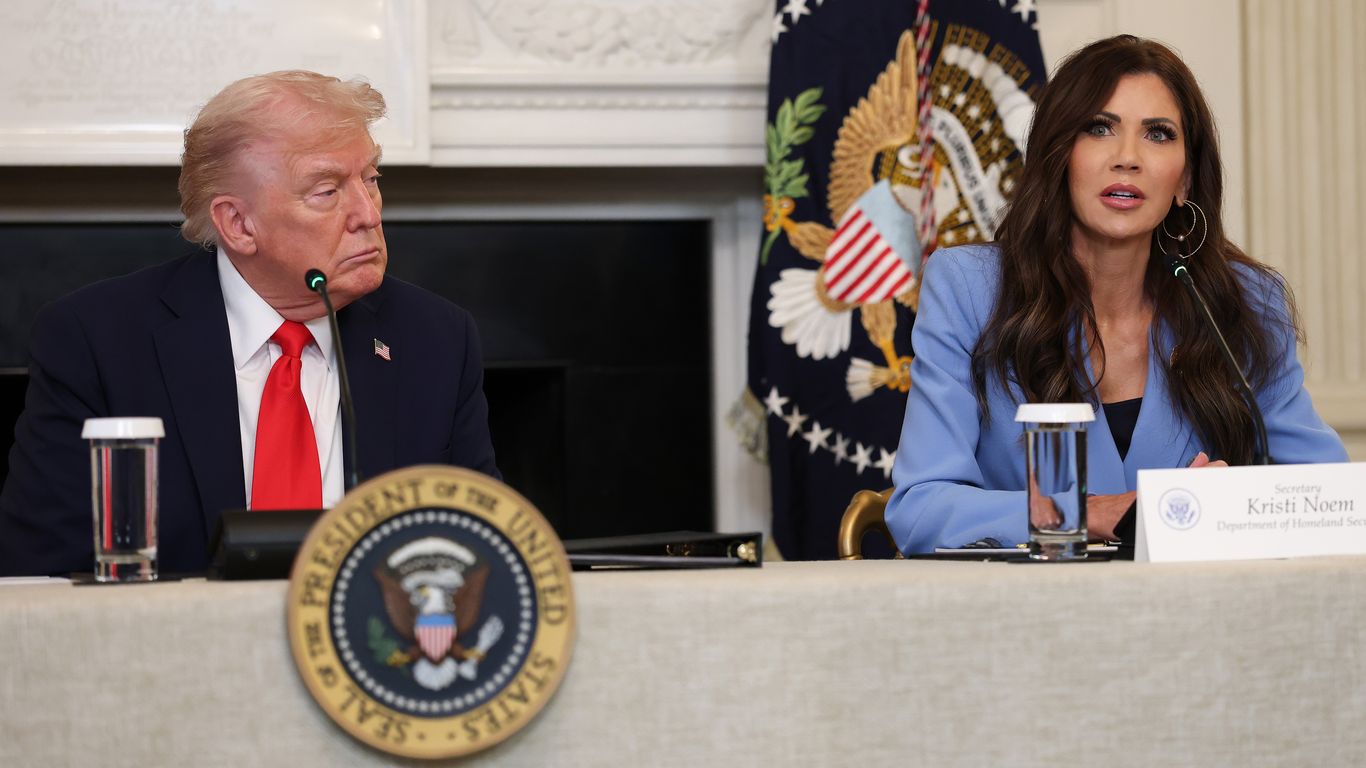
FEMA's pause affects hundreds of temporary disaster relief staff whose contracts were set to expire, with the looming storm cited as the primary reason. Homeland Security Secretary Kristi Noem visited headquarters for a briefing hours earlier, highlighting the storm's scale—bringing heavy snow, ice, and extreme cold across multiple states. Roughly 300 workers were let go this month alone, part of a 14% workforce reduction since last year, as the Trump administration pushes to reshape the agency and shift duties to states.[1][3]
Implications for Disaster Response
While the halt provides short-term relief, critics warn it strains state resources and questions long-term readiness. Former FEMA head Deanne Criswell noted staffing shortages hinder pre-positioning aid, potentially complicating recovery. This ironic storm saving jobs underscores tensions in federal emergency management.[2][4]
About the People Mentioned
Kristi Noem
Kristi Noem is a South Dakota politician born on November 30, 1971, in Watertown, South Dakota. She grew up on a family ranch and farm in rural Hamlin County. Noem graduated from South Dakota State University with a Bachelor of Arts degree in Political Science in 2011. She began her political career in the South Dakota House of Representatives, serving from 2006 to 2010, including a stint as Assistant Majority Leader. In 2010, she was elected to the U.S. House of Representatives, representing South Dakota's at-large congressional district for four terms until 2019. In 2018, Noem made history by becoming South Dakota's first female governor. She was reelected in 2022. During her tenure as governor, Noem focused on reducing taxes, cutting regulations, and promoting economic growth. Her approach to the COVID-19 pandemic, which included not implementing statewide lockdowns or mask mandates, garnered national attention. Noem is known for her conservative stance on issues like gun rights and border security. Noem has written two books: *Not My First Rodeo: Lessons from the Heartland* (2022) and *No Going Back* (2024). In January 2025, she resigned as governor after being confirmed by the Senate as the United States Secretary of Homeland Security, the first South Dakotan to hold this position. As Secretary, she oversees a department with over 260,000 employees and a budget exceeding $100 billion. Recently, while in her role as Homeland Security Secretary, Noem was involved in a controversial incident in Los Angeles where a U.S. Senator was forcibly removed from a press conference. Despite this, she continues to be a prominent figure in U.S. politics, particularly in conservative circles.
About the Organizations Mentioned
Department of Homeland Security
The **Department of Homeland Security (DHS)** is a U.S. federal agency established in response to the 9/11 terrorist attacks to safeguard the nation from a wide range of threats including terrorism, natural disasters, cyberattacks, and border security challenges. Its core mission is to protect the American people, critical infrastructure, and uphold national security by coordinating efforts across government and private sectors. DHS oversees immigration enforcement, cybersecurity, emergency response, and counterterrorism initiatives. Formed in 2002, DHS consolidated 22 federal agencies to create a unified structure for domestic security. Its key components include the U.S. Customs and Border Protection, the Federal Emergency Management Agency (FEMA), and the Transportation Security Administration (TSA). Over the years, DHS has played a critical role in preventing terrorist attacks, enhancing airport security, responding to natural disasters like hurricanes and pandemics, and advancing cybersecurity protections for government and private sector networks. In recent years, DHS has shifted focus towards emerging threats such as unmanned drone attacks on infrastructure, cyber intrusions into financial and critical systems, and disruptions to supply chains. Strategic visions for 2025 and beyond emphasize technological innovation, integration of intelligence, and public-private partnerships to address these complex challenges. The agency’s budget reflects its broad mandate, with over $400 billion allocated for fiscal year 2025, underscoring its significant role in national security and emergency preparedness. Notably, DHS has faced scrutiny and calls for reform, especially regarding immigration enforcement and internal mission clarity. Recent directives have expanded immigration enforcement powers to other federal law enforcement agencies, reflecting policy shifts under different administrations focused on border security. For business and technology sectors, DHS represents a major government player driving innovation in cybersecurity, disaster response technology, and infrastructure protection, while navigating evolving threats in a complex geopolitical landscape. Its ongoing modernization efforts aim to enhance resilience and adapt to future security challenges.
FEMA
The **Federal Emergency Management Agency (FEMA)** is a U.S. government agency under the Department of Homeland Security, established in 1979 by President Jimmy Carter to coordinate disaster response and recovery nationwide[1][2]. Its core mission is to manage federal assistance when disasters overwhelm local and state capabilities, providing expert support, funding, and resources to affected communities[1][2]. FEMA also focuses on preparedness and resilience-building before disasters through education, training, and engagement with local governments and organizations[2]. Historically, federal disaster aid dates back to the early 1800s, but FEMA was created to unify emergency management and civil defense efforts under one agency. Since its inception, FEMA has evolved to cover a broad range of hazards, including natural disasters like hurricanes, floods, and earthquakes, as well as man-made crises such as terrorist attacks[1][2]. The agency operates 10 regional offices and employs over 20,000 people, with workforce surges during major emergencies reaching up to 50,000[2]. FEMA's key achievements include coordinating large-scale federal responses to catastrophic events such as Hurricane Katrina, the Oklahoma City bombing, and more recently, the 2024 hurricanes Helene and Milton, where it approved billions in aid and deployed thousands of responders[1][2]. Beyond immediate disaster response, FEMA administers programs like low-interest disaster loans, grants for infrastructure rebuilding, and training for first responders[1]. It also manages floodplain mapping and flood insurance regulations critical for risk management and urban planning[3]. Currently, FEMA remains a pivotal agency in disaster management, increasingly integrating technology and data-driven strategies to improve emergency preparedness and response efficiency[1][2]. Its role extends to coordinating with state and local governments, nonprofits, and federal partners to enhance national resilience against evolving risks. Overall, FEMA represents a vital intersection of government, technology, and community engagement in safeguarding the United States from a wide array of emergencies.
Trump administration
The **Trump administration** refers to the executive branch of the U.S. federal government during Donald J. Trump’s presidency, initially from January 20, 2017, to January 20, 2021, and resuming with his second term starting in 2025. It was characterized by a mix of aggressive domestic policies, significant judicial appointments, and a distinct foreign policy approach that emphasized "America First" principles[4][8]. The administration’s key activities included **tax reform**, notably passing the $3.2 trillion Tax Cuts and Jobs Act, which represented the largest overhaul of the U.S. tax code in decades[5]. Trump also renegotiated trade agreements with major economies including Mexico, Canada, China, Japan, and South Korea, prioritizing bilateral deals over multilateral ones such as the Trans-Pacific Partnership (TPP), which the administration withdrew from early on[1][2]. The administration sought to protect American jobs by restricting cheap foreign labor and influencing agencies like the Tennessee Valley Authority to retain American workers[5]. On the judicial front, the Trump administration appointed over 200 federal judges, including three Supreme Court justices—Neil Gorsuch, Brett Kavanaugh, and Amy Coney Barrett—shaping the judiciary for years to come[4]. These appointments were among the most significant achievements, influencing U.S. law on multiple fronts. In foreign policy, the administration pursued a controversial agenda: it imposed travel bans on several predominantly Muslim countries, withdrew U.S. troops from northern Syria, and supported Saudi Arabia militarily despite congressional opposition related to the Yemen conflict[1][3]. It also fostered new international technology alliances, such as securing commitments from allies to exclude Chinese telecom giant Huawei from 5G infrastructure and signing AI cooperation agreements with the UK[5]. The Trump administration faced substantial political turmoil, including two impeachments by the House of Representatives—first in 2019 over Ukraine dealings, and again in 2021 following the January