Olympic Hockey Controversy: Crinon Suspended After Fight At Milan Cortina 2026
Olympic Hockey Controversy
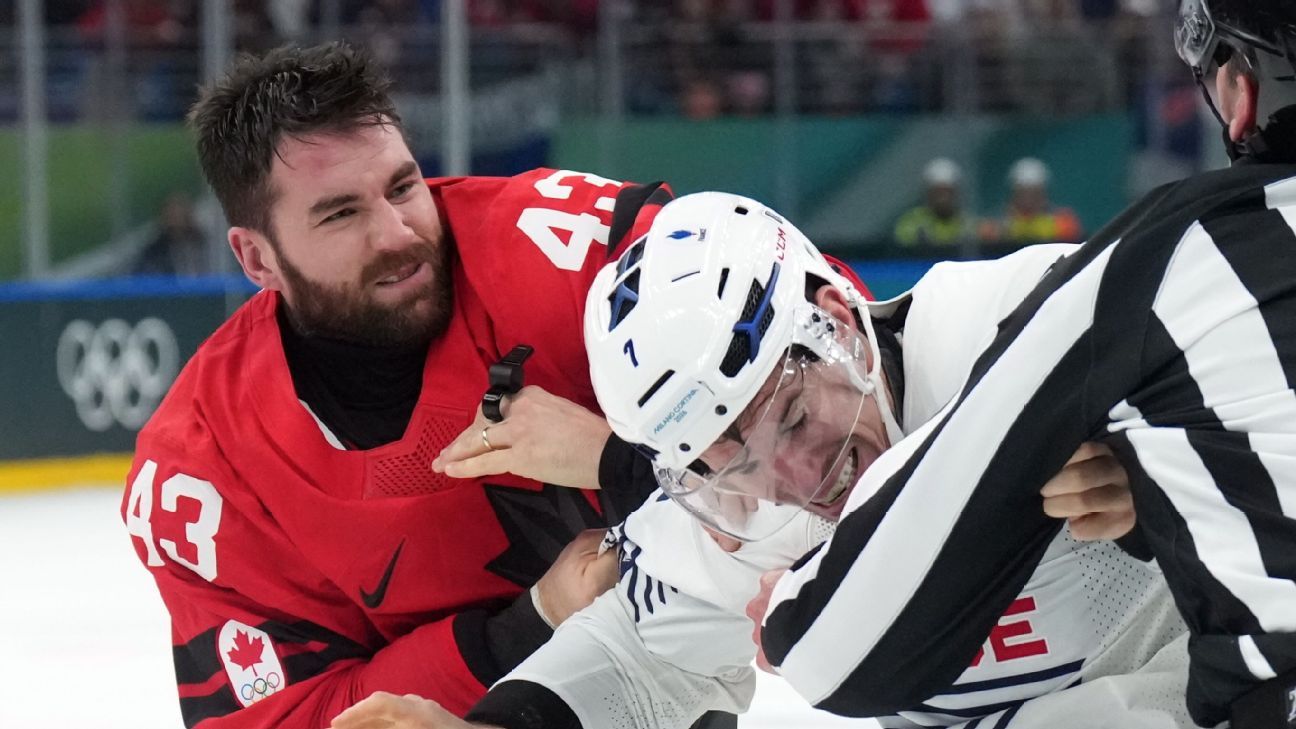
France's Pierre Crinon faced suspension from the Milan Cortina 2026 Winter Olympics after engaging in a rare fight with Canada's Tom Wilson during their men's hockey matchup. The incident occurred in the final moments of Canada's dominant 10-2 victory, marking the first Olympic hockey fight since 1998. Both players received game misconduct penalties under International Ice Hockey Federation rules, resulting in immediate ejection from the contest.
Disciplinary Action
While the IIHF imposed no further sanctions, France's ice hockey federation took independent action on Monday. Crinon's suspension stemmed not solely from the fight itself, but from his provocative behavior upon leaving the ice. The French federation stated that his conduct violated Olympic spirit and undermined the sport's values, making him ineligible for remaining tournament competition.
Contrasting Outcomes
Tom Wilson escaped additional punishment despite his enforcer reputation. Canada's coaching staff praised Wilson's decision to defend teammate Nathan MacKinnon following a shoulder check to the face. This incident highlighted differing disciplinary approaches between international federations and national governing bodies at the Olympic Games.
```About the People Mentioned
Tom Wilson
**Tom Wilson** is a Canadian professional ice hockey right winger and alternate captain for the Washington Capitals of the National Hockey League (NHL), born March 29, 1994, in Toronto, Ontario. Standing at 6'4" and weighing 225 pounds, he is renowned as a power forward known for his physical play, agility, and two-way game, having been drafted 16th overall by the Capitals in 2012.[3][4] Wilson debuted in the 2013 Stanley Cup playoffs at age 18, playing four games against the New York Rangers after his OHL season with the Plymouth Whalers. His rookie NHL regular season followed in 2013-14, where he set a career-high 14 fighting majors and quickly amassed over 1,000 penalty minutes and 60 fighting majors in his first seven seasons, establishing himself as one of the league's top agitators and heavy hitters.[1][3] A pivotal achievement came in 2018 when Wilson helped the Capitals win their first Stanley Cup, contributing 15 points in 21 playoff games, including an assist on the clincher against the Vegas Golden Knights.[1][3] He evolved his game post-suspensions, reducing physicality emphasis; in 2019-20, he posted career highs of 22 goals and 40 points in 63 games on the top line with Alexander Ovechkin and Nicklas Bäckström.[3] Other milestones include his 200th NHL point in 2021-22 and 500th game in 2020.[1] As of 2026, at age 31, Wilson remains a key Capitals contributor under contract through 2030-31, leading the league in penalty minutes at times (e.g., 96 in a recent season) while scoring consistently, with recent highlights like a Gordie Howe hat trick and goals against the Rangers and Panthers.[4][6] His career stats reflect sustained relevance: over 14 goals and 35 points in recent high-mark seasons, averaging nearly 16 minutes per game.[7]
About the Organizations Mentioned
International Ice Hockey Federation
```html <!DOCTYPE html> <html lang="en"> <head> <meta charset="UTF-8"> <meta name="viewport" content="width=device-width, initial-scale=1.0"> <title>International Ice Hockey Federation: Global Powerhouse of Puck Sports</title> <style> body { font-family: Arial, sans-serif; line-height: 1.6; max-width: 800px; margin: 0 auto; padding: 20px; } h1 { color: #1e3a8a; } h2 { color: #0f172a; } .highlight { background-color: #dbeafe; padding: 2px 4px; border-radius: 4px; } </style> </head> <body> <h1>International Ice Hockey Federation: Driving Global Growth in a Tech-Savvy Sport</h1> <p>The <strong>International Ice Hockey Federation (IIHF)</strong>, founded on May 15, 1908, in Paris as Ligue Internationale de Hockey sur Glace, serves as the worldwide governing body for ice hockey and inline hockey, headquartered in Zurich, Switzerland[1][2][5]. With <strong>84 member associations</strong>, it standardizes rules, manages player transfers, and oversees officiating to ensure fair play globally[1][5][6].</p> <h2>Rich History of Expansion</h2> <p>Starting with Belgium, France, Great Britain, and Switzerland, the IIHF grew rapidly. Ice hockey debuted at the 1920 Olympics, integrating Canada and the US, who dominated early tournaments[1][3]. Key milestones include the 1924 Olympics as the first World Championship, the 1965 European Cup inspired by soccer's Champions League, and compromises in 1977 allowing NHL pros in IIHF events pos
France's ice hockey federation
The **French Ice Hockey Federation** (Fédération Française de Hockey sur Glace, FFHG) serves as the governing body for ice hockey in France, overseeing both amateur and professional competitions as well as junior and senior national teams.[1] Founded in 2006 following its separation from the broader French Ice Sports Federation, the organization has become instrumental in developing the sport at all levels.[1] France's ice hockey heritage runs deep, with the sport's origins tracing back to the early 20th century when British expatriates introduced it to the country.[4] The nation became a founding member of the International Ice Hockey Federation (IIHF) in 1908, establishing itself as a pioneering force in the sport.[2] The French national team achieved notable early success, finishing fifth at three consecutive Olympic Games (1920, 1924, and 1928).[3] Under the leadership of inaugural president Luc Tardif from 2006 to 2021, the federation established itself as a modern governing body.[1] Tardif's successor, **Pierre-Yves Gerbeau**, currently leads the organization.[1][2] The federation relocated its offices to a state-of-the-art national training center in Cergy, Val-d'Oise in 2016, reflecting its commitment to infrastructure development.[1] Recent achievements demonstrate France's resurgence in international hockey. The men's team qualified for the 2018 World Cup quarterfinals after a 28-year absence from the tournament.[4] More impressively, the junior men's teams have claimed World Cup medals in three of the past four editions, including silver medals in 2013 and 2023, plus bronze in 2021.[4] France's men's team currently ranks 14th globally, while the women's team